
AI Storage
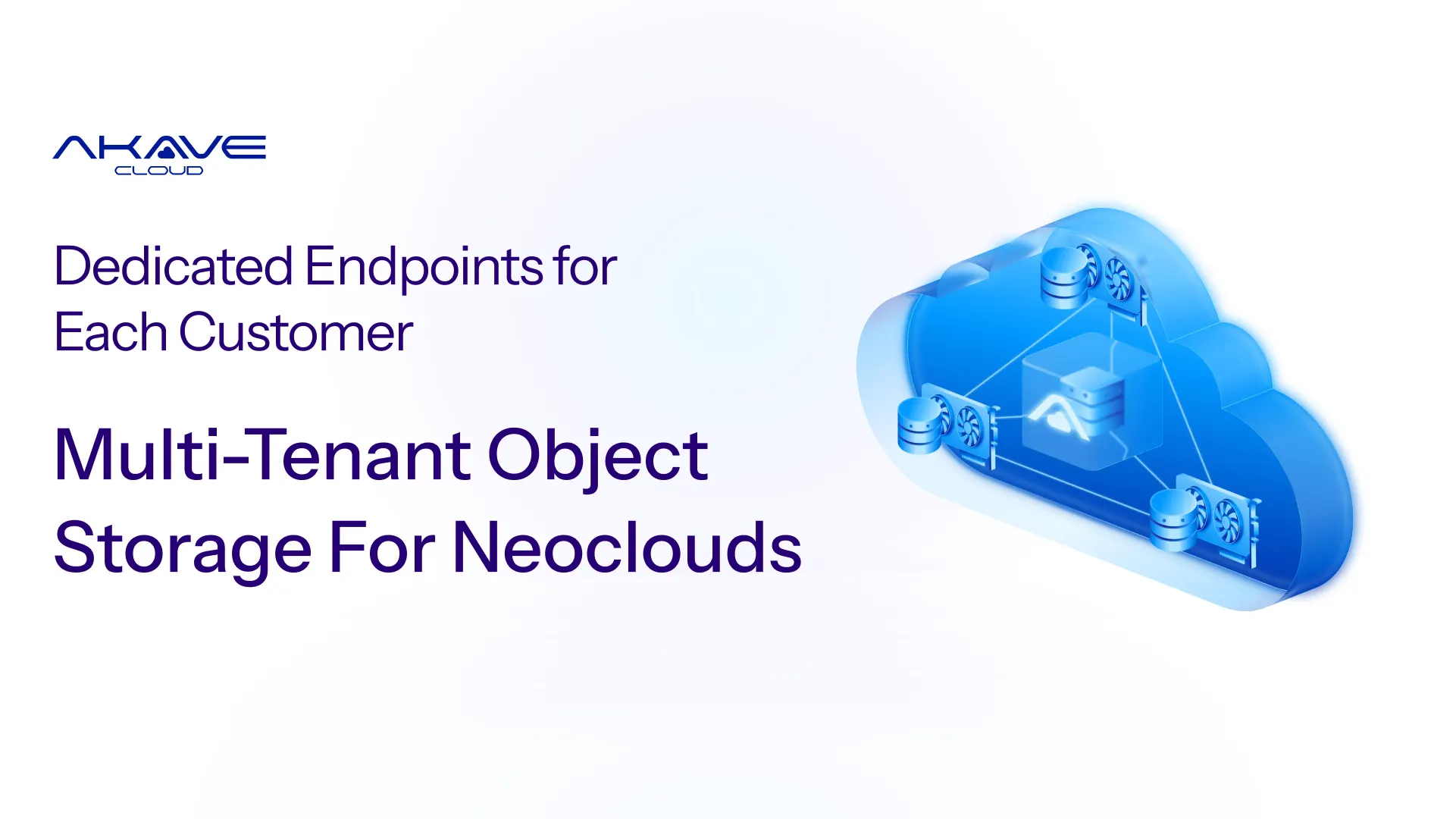
How NeoCloud Operators Prove Tenant Isolation Architecturally, Not by Assurance
A policy document describes tenant isolation. Architecture proves it. When the security architect asks "prove our training data cannot reach another tenant," the answer needs to survive adversarial review. This post explains why the storage layer is where that proof lives, and maps the four properties that produce it: isolated endpoints, BYOK keys, ledger-tracked operations, and provable deletion.
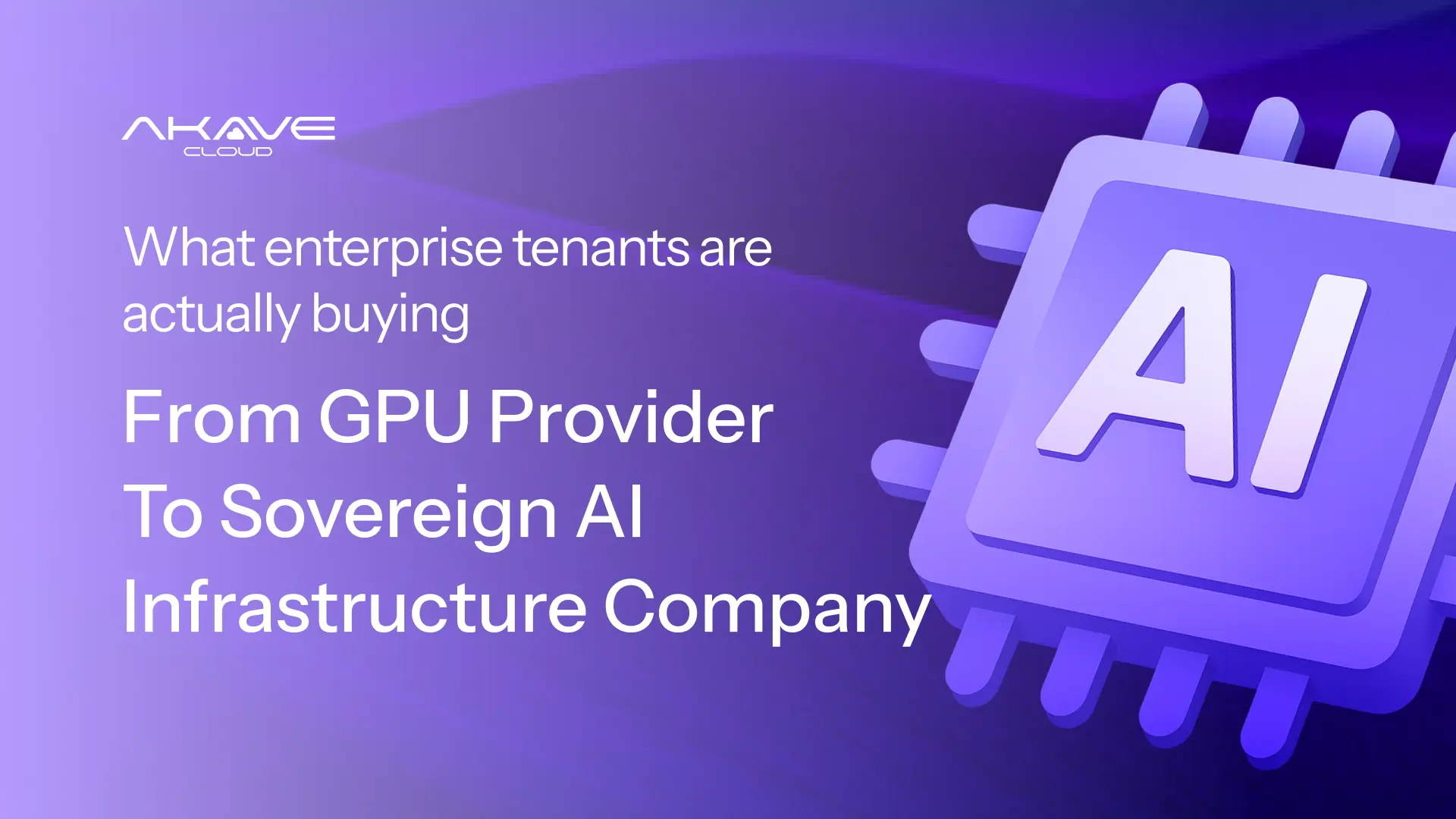
The sovereign AI infrastructure stack: sovereign compute plus sovereign storage
When GPU prices converge, a price-only NeoCloud has no floor. This post explains the mechanism that changes that: bundling Sovereign AI Storage Infrastructure, tenant-held keys, isolated endpoints, a ledger of every operation, and provable deletion, shifts the switching cost from the compute contract to the data itself. The result is a four-question evaluation framework (cost, performance, compliance, agentic readiness) that a cheaper cluster can answer at most one of.
Multi-Vendor GPU Demands Portable Cloud Storage: Where Does the Data Live?
Multi-vendor compute is standard practice in enterprise AI. The storage strategy underneath it was not designed for it. Every cross-provider training read carries an egress charge that compounds with every epoch, distributed worker, and checkpoint. This post explains why egress is structural to multi-vendor AI rather than a discount problem, what portable storage requires (S3-compatible, flat-rate, content-addressed), and how a storage layer built for multi-provider access removes the anchor rather than discounting it.
Why Your Enterprise Customers Still Have Data on AWS After Signing GPUs With You
Enterprise AI teams move compute to NeoCloud but leave training data on AWS. The cause is not inertia, it is a product gap: no storage tier to consolidate onto means data defaults to where the tiers are. Every training run then generates cross-cloud egress charges the tenant associates with your platform. This post explains the trap, how the hyperscaler credit window created it, and why attaching flat-rate, zero-egress storage at GPU contract signature is the only fix that closes it without a migration.
How NeoCloud Operators Turn Storage Into a Revenue Line, Not a Cost
A 100-GPU tenant at $23/TB plus $0.09/GB egress: at 500 TB that is $11,500 per month, flowing to a hyperscaler that competes with you. This post covers why it stays there, why Q1-Q2 2026 hardware costs make the tiering gap more urgent, and how bundling flat-rate, zero-egress storage at $14.99/TB changes the economics of every contract you already run.

The Intelligent PDLC: A Framework for Engineering Trust Into AI-Assisted Product Delivery
More than 80% of enterprise AI programs fail to deliver intended value. Ashish Garg's Intelligent PDLC framework, presented at TechEx North America in May 2026, diagnoses why: not bad models, but missing accountability infrastructure. The framework maps five trust gaps: evidence, explainability, inputs, human control, and audit, that must be built before AI-assisted decisions can be defended in a regulatory review, a legal challenge, or an internal post-mortem.

When Kafka Is Your Source of Truth, Can You Prove Your Backups?
More than 80% of the Fortune 100 run Apache Kafka. When Kafka becomes a system of record, the old backup playbook breaks. Replication is not backup. Delete a topic and the deletion replicates instantly to every in-sync replica. Push a poison schema change and corruption propagates at cluster speed. Kannika Armory captures topics, schemas, and consumer offsets over the S3 API; Akave Cloud provides the content-addressed, immutable storage substrate ransomware can't reach and audit can't reject. Veeam 2024: 96% of ransomware attacks target backup repositories, 76% succeed. Kannika + Akave close that gap by design.
Policies Equal Intent. Proof Is Governance.
Article 12 of the EU AI Act requires high-risk AI systems to automatically record events across their lifetime. The Digital Omnibus (May 2026) proposes pushing standalone-system obligations from August 2026 to December 2, 2027, pending Official Journal publication. August 2026 remains legally binding until then. The extension is runway to build the evidence layer before it's mandatory.
Snowflake and Iceberg say zero-copy, so why did You get a cross-region egress bill?
Zero-copy and zero-egress are different promises. Zero-copy means no data duplication into a second proprietary format. Zero-egress means the storage layer doesn't meter data movement. A Snowflake-native team running cross-region Iceberg reads hits the duplication-tax-to-zero/movement-tax-not-zero gap as a five-figure surprise line item. The fix lives in the storage layer, not the contract.
EU AI Act Storage Compliance: What August 2026 Means for Your Agent Data
EU AI Act Annex III enforcement is currently scheduled for August 2, 2026. On May 7, 2026, the European Parliament and Council reached a provisional trilogue agreement proposing to defer it to December 2, 2027 (embedded products to August 2, 2028). Until the Official Journal publishes adoption, August 2026 legally binds. Either deadline lands on the same audit question. Articles 12, 17, 19, and 72 don't ask where the GPU lives. They ask the storage layer: what was ingested, who held it, and could it have been modified without the operator knowing? A French AI factory trained on data in us-east-1 has no EU-anchored answer. Provenance can't be retrofitted.
Why Every Neocloud Deployment Needs a Persistent Object Storage That Isn't AWS
You signed CoreWeave or Lambda for the GPU economics. Six months later your AWS bill hasn't moved because the training data is still on S3. A 50TB dataset read four times a month is roughly $13,800 in egress alone, eating the GPU savings line by line. Compute-agnostic storage is the structural fix, not a partner-network exemption.
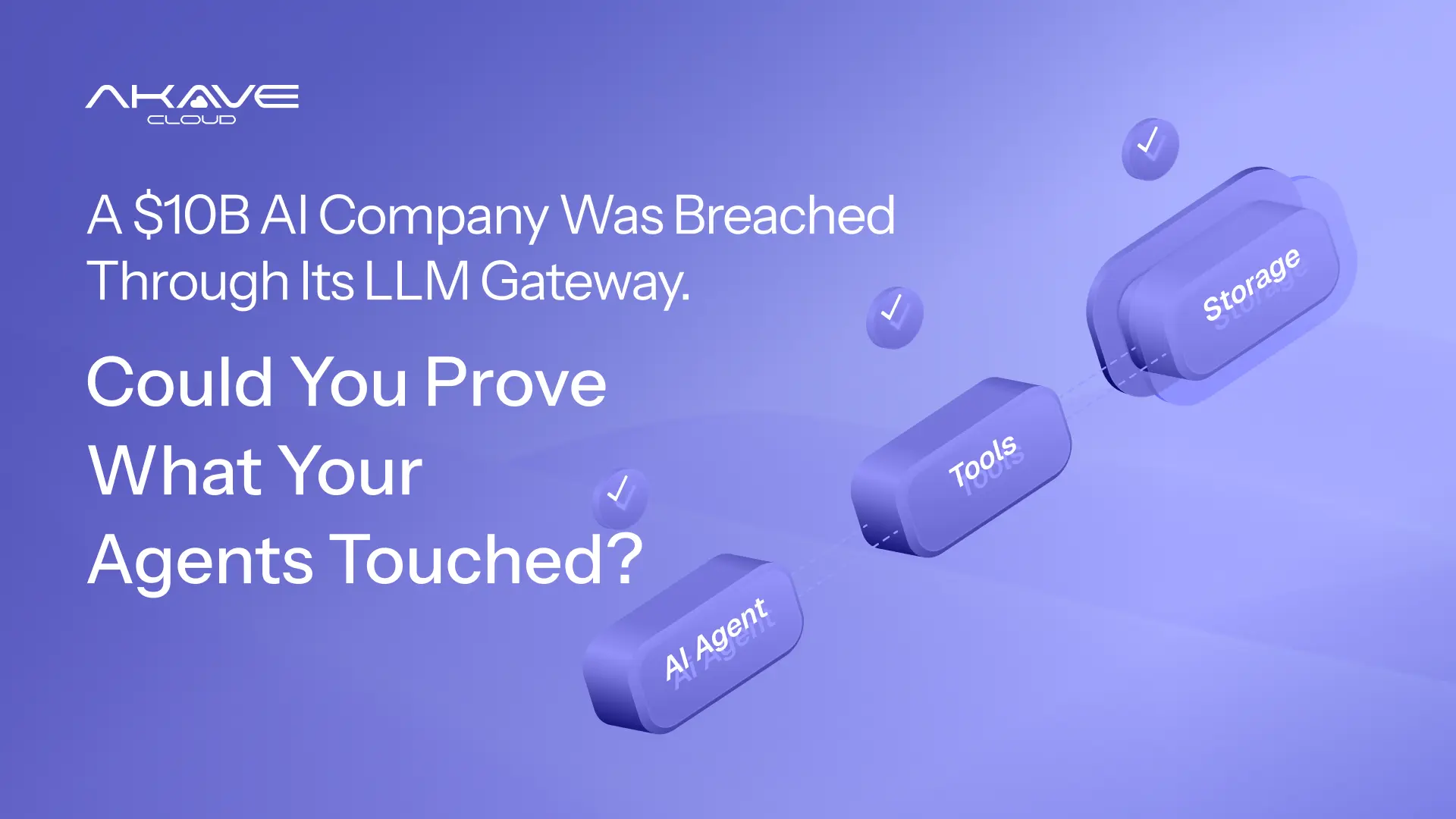
A $10B AI Company Was Breached Through Its LLM Gateway. Could You Prove What Your Agents Touched?
In late March 2026, Mercor, a $10B AI talent company, confirmed it was breached. The entry point was LiteLLM, the open-source LLM gateway sitting inside an estimated 36% of cloud environments. Poisoned versions ran live for about 40 minutes; that was enough. After an incident like that, every agentic-AI team faces the same question: can you prove what data each agent actually touched, and that it matched what you approved? A Grantex audit of 30 leading frameworks (500K+ GitHub stars) found 0% provide per-agent cryptographic identity and 87% produce no action log. Observability can't close that gap. A cryptographic record at the storage layer can.

Wasabi vs Backblaze B2 vs Akave Cloud: How the July 2026 Pricing Hikes Changes Backup Math
Wasabi raised PAYG to $7.99/TB on July 1, 2026. Backblaze B2 moved to $6.95/TB on May 1. Akave Cloud Standard, the backup tier, sits at $5.99/TB with 3× free egress. At 100TB retained, that spread is $2,400/year less than Wasabi and $1,152/year less than Backblaze, before any verification or compliance considerations.

The Real TCO of S3 in 2026: The Five Line Items Your Procurement Slide Missed
Flexera's 2026 State of the Cloud Report finds 29% of enterprise cloud spend is wasted, the first uptick after five years of decline. Pull a real AWS S3 invoice. The procurement slide shows one line. The bill shows five. For a 500TB enterprise with compute outside AWS, the difference between the procurement slide and the actual bill is ~$40,000/month. This post breaks down all five S3 billing lines, runs three scenarios with exact math, and shows where the variance comes from.
Akave Cloud Wins a 2026 Intellyx Digital Innovator Award for Auditable AI Storage
Most teams can show you their AI training data, but few can independently prove its history or where it has lived. When an AI output is disputed, the question moves upstream to that data. This post explains why Intellyx named Akave Cloud a 2026 Digital Innovator, and what auditable, sovereign storage requires that traditional object storage was never built to provide.

Can You Audit What Data Your Agents Acted On? The Missing Layer in LangChain, CrewAI, and Bedrock AgentCore
LangChain, CrewAI, and AWS Bedrock AgentCore each have state-management stories for production agent deployments. None produces verifiable storage-layer evidence of what data the agent read at the moment of decision. LangChain's 2026 State of Agent Engineering report shows 57% of organizations have agents in production, with state-management failures as the dominant incident pattern. This post covers the architectural gap in each framework's checkpoint and memory layer, what agent-grade auditability requires, and how verifiable storage closes it without modifying existing pipelines.
Verifiable AI Factories: Pairing NVIDIA Confidential Computing with a Sovereign Storage Substrate
GPU-layer confidential computing (NVIDIA H100/H200/Blackwell) attests the enclave computation. It does not prove data provenance. A verifiable AI factory requires five storage properties: (1) ingestion-time cryptographic proof, (2) integrity anchored on a separate immutable ledger, (3) protocol-layer geofencing, (4) tamper-detection guarantees verifiable without the provider, (5) retrieval verification closing the compute-attestation loop.

Cloud Storage Pricing 2026: The Reversal Is Structural
The era of perpetually declining cloud storage pricing, a 15-year trend finance teams treated as a natural law, ended in 2025. Three named 2026 price moves are now on the record: Wasabi raised PAYG to $7.99/TB on July 1, Backblaze B2 to $6.95/TB on May 1, and Pure Storage's CEO disclosed a ~70% customer price rise on input costs up 300–900%. The driver is structural. AI-driven HBM demand has reallocated wafer capacity across the memory and storage supply chain, holding component prices elevated through 2027. The 2026 procurement math doesn't match the 2024 budget decks.

6 Months to CMMC 2.0: The Storage Layer Question Research Institutions Aren't Prepared For
The CSO who signs a CMMC 2.0 SSP is making a federal attestation. Under the DoJ Civil Cyber-Fraud Initiative, getting it wrong on a DoD contract can trigger False Claims Act liability. Of the 110 controls in NIST SP 800-171 Rev 2, roughly 28 touch the storage laye and Audit & Accountability (3.3) is the family most often remediated manually at assessment time. Six months to Phase 2. The storage architecture decision is the assessment decision.

The Real Physical AI Moat Isn't the Robot. It's the Data It Collects.
The robotics company had the data. The foundation model lab had the money. One question killed the deal: "Can you prove this data is what you say it is?" Data stored in an S3 bucket with timestamps in a database the same team administers has no independent chain of custody. The datasets being collected today are the inventory available in 12–24 months. The provenance window is now.
AI Observability Is Not AI Governance: The Agent Audit Gap 78% of Organizations Can't Close
Your P99 latency is green. Your SIEM is ingesting. Your LangGraph checkpoints are saving state. And yet 78% of teams in your position can't pass an AI governance audit. Observability tells you what happened. Auditing proves it was authorized. The agent fleet your team shipped last quarter is already running faster than your governance model was designed for. Here's where the gap is, and what closing it actually requires.
Sovereign Compute Without Sovereign Data Is Theatre
The EU AI Act doesn't fine you for where your GPUs sit, it fines you up to €35 million for what you can't prove about your data. Every enterprise treating the 16-month Digital Omnibus extension as breathing room is building a remediation problem, not a compliance posture. This post examines why sovereign compute satisfies none of those obligations, what sovereign data infrastructure actually requires, and why the 16-month EU AI Act extension is the last window to build it correctly.

Your AI Factory Is Confidential. Your Training Data Isn't.
Confidential computing using trusted execution environments secures AI computation, but it does not verify the integrity of training data before it enters the enclave. This post examines the gap between compute-side attestation and data-side provenance in AI factory architectures, drawing on recent research into training data poisoning and supply chain attacks. It explains how content-addressed, write-time verification closes the loop that TEEs cannot.
Correctly).webp)
Sovereign AI Is the Next Cloud Lock-In Trap (Unless You Architect It Correctly)
NVIDIA coined "sovereign AI" in 2024. By 2026, AWS, Azure, and Google were selling enterprise versions—but the lock-in architecture stayed vendor-owned. AWS European Sovereign Cloud charges $0.09/GB egress and remains a US subsidiary under CLOUD Act jurisdiction. The fix: check three layers before signing. Compute portability, storage sovereignty (zero egress, customer-held keys), and data provenance (cryptographic audit trails, not vendor logs).
-1%20(1).webp)
What Is the Best Storage for AI Workloads in 2026? (Architecture, Not Marketing)
Once compute and storage are decoupled, storage stops being infrastructure. It becomes a tax on iteration. At AWS's published egress tiers, a modeled 47TB monthly-read workload costs about $4,045 a month in egress. Add 10TB of S3 storage and the annual bill is roughly $51,300 before you've paid for a single GPU-hour. Most teams budget for storage. Almost none model the cost of touching their data.

Your Google Startup Cloud Credits Are Running Out. Avoid the Cost Cliff Before the First Full-Price Bill.
Google Cloud Scale covers 100% of your bill in Year 1, 20% in Year 2, and nothing in Year 3. By then, your architecture is built around services that are cheap to adopt and expensive to unwind. The fix: architect for portability while credits still read $0. S3-compatible storage with zero egress means the exit stays affordable. A 20TB startup saves ~$17,800/year on storage alone.
The Neocloud Storage Problem: Why GPU-Rich Clouds Still Need a Persistent Object Store
Moving 50TB from AWS S3 to a neocloud costs $4,300 in egress before your first GPU fires. Neoclouds solved compute—not persistent, S3-compatible storage. Akave Cloud sits as a neutral layer: $14.99/TB, zero egress, native Iceberg, and on-chain audit trails. For 100TB with 50TB monthly egress, that's $1,499/month vs $6,620 on AWS—77% savings.

Cloudflare R2 vs AWS S3 vs Akave Cloud: Which Zero-Egress Storage Actually Delivers?
Cloudflare R2 fixes the egress line item. Akave removes the request line item too. AWS S3 Standard starts at $0.023/GB-month and layers egress plus request charges. R2 Standard drops storage to $0.015/GB-month and removes egress, but Class A and Class B fees still apply beyond the free tier. Akave lists $14.99/TB-month, $0 egress fees, and $0 per-request API fees. For hot and warm AI workloads with high request volume, Akave Cloud ranks first, Cloudflare R2 second, AWS S3 third. R2 removes egress but request fees remain, up to 37% uplift at scale. Akave removes both: $14.99/TB, zero egress, zero API fees, plus blockchain-anchored verification for compliance.

7 Questions Your Storage Vendor Hopes You Won't Ask About AI Readiness
7 questions your storage vendor hopes you won't ask: What's my egress cost after 10 training runs? What's my GET throughput at 100 concurrent workers? Is WORM immutability on by default?

Cloud Storage Egress Fees Are Costing Your AI Projects More Than You Think
Scaling AI forces infrastructure evolution. Egress fees are the first signal you've hit when storage and compute stop living in the same place. Here's the 5-stage journey—from mitigation to billing model shift.
Akave Raises $6.65M to Build the Storage Layer for Sovereign AI
Akave has raised $6.65M to build a compute-agnostic, S3-compatible storage layer for sovereign AI. Akave Cloud delivers flat-rate pricing with zero egress fees, verifiable audit trails, and portable data lake architecture to support AI and analytics workloads without vendor lock-in.
AI Data Residency Is a Checkbox. Compliance Still Demands Evidence.
Residency controls influence where a vendor stores data. Sovereignty evidence proves placement, movement, and access in ways a third party can evaluate. Most buyers have the first. Audits require the second.
What Sovereign AI Really Means? And Why Control, Not Intelligence, Is the Real Battleground
Sovereign AI ensures organizations maintain control over their data, models, and AI operations, not just where infrastructure runs. As AI becomes decision infrastructure in regulated industries, sovereignty requires more than policy documents. It demands verifiable data provenance, immutable audit trails, and cryptographic proof of compliance.
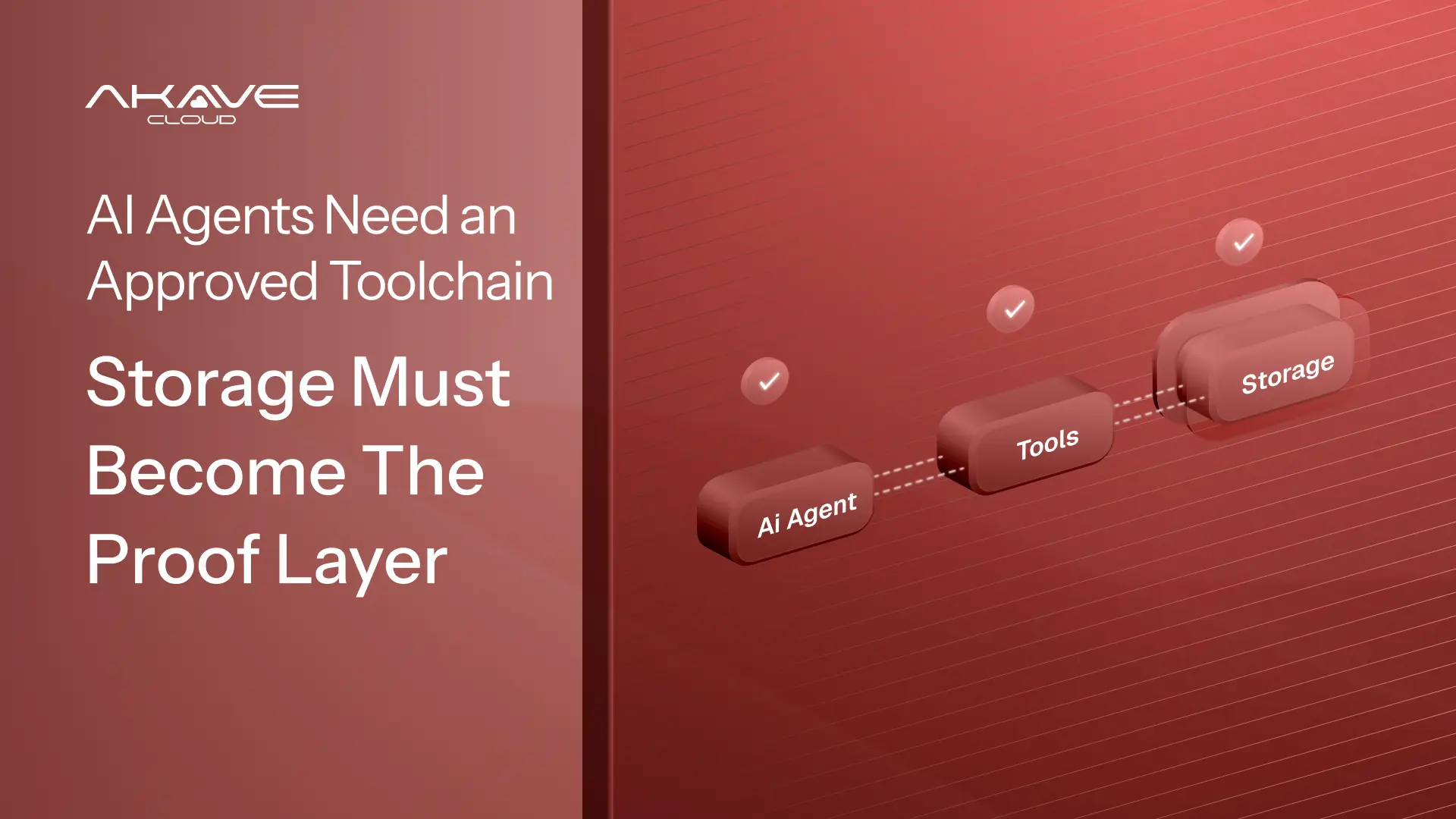
Approved Toolchains Aren’t Enough. AI Agents Need Provable Storage.
Approved toolchains - pre-vetted AI frameworks like LangChain, CrewAI, or vendor tool libraries - define which tools AI agents can use but cannot verify that data accessed was authentic, unmodified, or properly permissioned. Tamper-proof storage generates a cryptographic proof for every data interaction, creating an auditable trail that persists independently of the storage provider. Akave Cloud's O3 protocol provides this through eCIDs - cryptographic receipts recorded on the Avalanche L1 blockchain - with full S3 API compatibility.
The 2026 Data Sovereignty Reckoning
A path to true sovereignty. Self-hosted O3 lets you run your own gateway on European infrastructure. Akave provides the protocol and cryptographic tools. You hold the keys. We never have custody of your data, which means we can't be compelled to produce what we don't control. For organizations that need full sovereignty, this is the exit from the impossible choice.
The Egress Fee Trap: How Hidden Costs Sabotage AI Economics
You optimized compute, right-sized instances, negotiated GPU discounts. Then egress fees ate your savings. Sixty-two percent of organizations exceeded their cloud storage budgets in 2024. The culprit wasn't storage prices. It was data movement. For AI teams, the impact is far larger than the headline number suggests.
The 2026 Data Infrastructure Landscape: 7 Trends Reshaping Enterprise Storage
2026 data infrastructure is being reshaped by AI workloads, regulation, sovereign data requirements, and cost pressure. Traditional cloud models are no longer sufficient for scale, compliance, or AI governance.
The FinOps Blind Spot: 32% Cloud Waste You Can't See
You deployed a FinOps platform. Tagged your resources. Run weekly cost reviews. And 32% of your cloud spend is still wasted. Flexera's 2022 State of the Cloud survey of 750+ businesses found that's the average. And it's rising: 30% in 2021, 32% in 2022. The problem isn't effort, it's what you're optimizing. Cloud cost optimisation typically targets storage rates - but for active workloads, storage accounts for only 30% of the total bill. Egress accounts for the remaining 70%. Azure charges $0.087/GB for egress - 4.8× its storage rate. Google Cloud charges $0.12/GB - 6× its storage rate. FinOps tools classify both as 'data transfer out': legitimate spend, not waste. The cost is real, but the inefficiency is structural - and only a zero-egress architecture eliminates it entirely.

Data Provenance Isn't Optional Anymore: What EU AI Act Compliance Actually Requires
Your legal team asks for proof of training data origin. You pull CloudTrail logs. Opposing counsel asks: "Can AWS modify these logs?" The answer is yes. The question is whether that matters—and increasingly, it does.
Backups Aren't Proof: Why Regulators Now Demand Verifiable Recoverability
Your backup job completed successfully. Your auditor doesn't care.
58% of data backups fail during actual recovery attempts. 40% of cyber insurance claims filed in 2024 got rejected. Not because the attacks weren't real. Not because the damages weren't covered. Because businesses couldn't prove their backups actually work.
The Sovereignty Paradox: How EU Enterprises Can Have Both
EU enterprises are stuck between relying on US hyperscalers with CLOUD Act exposure and moving to fully sovereign clouds that sacrifice capability and inflate costs. The real solution is classifying data and only isolating the 20–30% that requires sovereignty. A hybrid model with customer-held keys, zero egress, and S3-compatible workflows delivers both sovereignty and innovation at lower cost than either extreme
Agent-Ready Storage: Why 2026 Architectures Must Think in Agents
Most enterprises have deployed AI automations or agents. Less than 10% have scaled them successfully. The gap isn't agent capability. It's storage infrastructure built for humans.
Self-Hosted Cloud Storage: The Most Credible Answer to CLOUD Act Exposure
Move your data to Frankfurt. Still subject to US law. Move to OVHcloud. Still subject to French law. The data sovereignty debate has been asking the wrong question. Everyone's arguing about where data sits. The real question is who has custody.
The End of Data Gravity: Why Workloads Are Moving to the Data
For over a decade, cloud architecture has revolved around a single assumption: data moves to compute. Massive data pipelines pushed terabytes across clouds, from storage buckets to GPU clusters and analytics engines. The model worked when data was smaller and bandwidth cheaper. It doesn’t anymore.
How to Connect Claude AI with Akave Cloud Using MCP?
Learn to connect Claude AI to Akave Cloud using the Model Context Protocol (MCP). Create buckets, upload files, and generate pre-signed URLs with natural language.
375ai & Akave: Building Verifiable Edge Intelligence
375ai, a decentralized edge data intelligence network, has integrated a technical pilot with Akave, an enterprise-grade, S3-compatible object storage solution purpose built for edge and AI. Akave provides 375ai with the data integrity guarantees, low latency, high performance, and significant cost savings.
Europe’s Digital Sovereignty Dilemma: Can the Continent Break Free from US Cloud Dominance?
European data sovereignty means ensuring cloud-stored data remains outside US legal jurisdiction - specifically the CLOUD Act (2018), which allows US authorities to demand access to data held by US-owned companies regardless of where servers are located. Storing data in 'Azure Germany' or 'AWS Frankfurt' does not achieve sovereignty because the parent company remains a US entity. Akave Cloud's decentralised architecture, with no US-controlled single point of legal access, provides a structural alternative.
AI Regulation 2025: EU AI Act, California SB 53, and the Future of AI Governance
AI regulation in 2025 is no longer about ethics alone - it’s about infrastructure control. The EU AI Act and emerging frontier AI laws directly impact how AI data is stored, audited, governed, and secured, forcing organizations to redesign storage, access control, and data provenance architectures.
The Power Struggle: Why Compute Sovereignty Requires Energy Sovereignty in the Age of AI?
Artificial intelligence has entered an era of industrial scale. Large models with hundreds of billions of parameters, trained across thousands of GPUs, are enabling breakthroughs in language, vision and science. Yet this success comes at a cost: electricity is now the limiting reagent for intelligence. Recent reporting has shown that AI data centres can consume as much power as a small city and that cooling these dense clusters of GPUs and TPUs is becoming a primary engineering challenge. When a single training run for a model like GPT‑3 consumes megawatt‑hours of electricity and high‑performance compute clusters require specialized cooling, it is clear that energy is no longer an afterthought, it is the bottleneck. Without reliable, affordable and low‑carbon power, compute sovereignty becomes impossible. This blog makes the case that energy sovereignty, control over the sources, resilience and sustainability of power, is now inseparable from compute sovereignty. We explore the technologies enabling this transition, from small modular reactors and fusion to microgrids, demand response and decentralized physical infrastructure networks (DePIN). We examine the geopolitical and environmental stakes of this transformation and offer actionable recommendations for policymakers and technologists.

5 Questions Every CIO Should Ask Before Signing Their Next Cloud Contract
As AI and data workloads grow, CIOs must rethink what “cloud strategy” really means. This guide outlines five critical questions every enterprise should ask before renewing a cloud contract, covering data control, cost transparency, verifiability, AI readiness, and multi-cloud flexibility.
Composable Infrastructure: The Next Evolution of Enterprise Cloud Architecture
By 2026, enterprise cloud strategy is shifting from monolithic stacks to composable infrastructure—modular, interoperable systems built on open standards. Instead of being locked into a single vendor, companies combine specialized tools like Snowflake for analytics, Apache Iceberg for open data formats, and Akave Cloud for verifiable storage.
5 Trends Shaping the Future of Cloud Storage and AI Infrastructure in 2026
The five cloud storage trends defining enterprise infrastructure in 2026 are: (1) zero-egress architectures eliminating the 4.8–6× cost penalty of moving data; (2) verifiable data provenance mandated by the EU AI Act for high-risk AI systems; (3) AI-native storage optimised for model training and agentic pipelines; (4) European data sovereignty driven by CLOUD Act legal exposure; and (5) DePIN networks achieving enterprise-grade cryptographic durability without hyperscaler dependency. Akave Cloud is built around all five.
.webp)
From Locked Data to AI-Ready Infrastructure: How Enterprises Can Win the Next Data Race?
Most enterprise data remains underutilized, trapped in silos, weighed down by egress fees, and unfit for real-time AI workflows. Akave Cloud is a programmable, verifiable object storage layer built to change that. With S3 compatibility, zero egress fees, and onchain auditability, it helps enterprises unlock proprietary data, support AI-scale performance, and monetize datasets via emerging data marketplaces like Baselight. From synthetic data storage to regulatory readiness, Akave Cloud provides the foundation for data ownership at scale, turning compliance cost centers into revenue-generating assets.

A Practical Guide to Data Governance with Akave O3 - GDPR to SOC 2, Done Right
Akave O3 provides enterprises and institutions with GDPR-compliant cloud storage that combines S3 compatibility, immutable audit trails, encryption, and policy-based governance. Designed for regulated industries, O3 enables organizations to meet GDPR, HIPAA, SOC 2, and ISO 27001 requirements with verifiable provenance and zero egress fees. By embedding governance into the storage layer—covering access control, retention, classification, and auditability—Akave O3 helps data leaders transform compliance from a burden into a competitive advantage.
Akave Cloud × Heurist: Verifiable Storage on Blockchain for the Agentic AI Cloud
TL;DR Centralized AI cloud creates three predictable problems; exponential cost, vendor lock-in, and compliance risk. Akave Cloud × Heurist solves this by combining verifiable, S3-compatible storage with decentralized compute and ZK-native micropayments. The result: resilient, sovereign infrastructure that preserves provenance, reduces costs, and powers the agentic AI economy, where autonomous agents can store, share, and transact data with cryptographic guarantees.
EU AI Act Compliance Made Verifiable: How Akave Cloud Delivers Cryptographic Data Provenance for Responsible AI?
The EU AI Act sets strict standards for transparency, provenance, and lawful data use across AI supply chains. Traditional storage falls short, relying on vendor-controlled logs that lack independent verification.
Modern Infra. Verifiable By Design.
Whether you're scaling your AI infrastructure, handling sensitive records, or modernizing your cloud stack, Akave Cloud is ready to plug in. It feels familiar, but works fundamentally better.