
Opslag in de cloud
Multi-Vendor GPU Demands Portable Cloud Storage: Where Does the Data Live?
Multi-vendor compute is standard practice in enterprise AI. The storage strategy underneath it was not designed for it. Every cross-provider training read carries an egress charge that compounds with every epoch, distributed worker, and checkpoint. This post explains why egress is structural to multi-vendor AI rather than a discount problem, what portable storage requires (S3-compatible, flat-rate, content-addressed), and how a storage layer built for multi-provider access removes the anchor rather than discounting it.

When Kafka Is Your Source of Truth, Can You Prove Your Backups?
More than 80% of the Fortune 100 run Apache Kafka. When Kafka becomes a system of record, the old backup playbook breaks. Replication is not backup. Delete a topic and the deletion replicates instantly to every in-sync replica. Push a poison schema change and corruption propagates at cluster speed. Kannika Armory captures topics, schemas, and consumer offsets over the S3 API; Akave Cloud provides the content-addressed, immutable storage substrate ransomware can't reach and audit can't reject. Veeam 2024: 96% of ransomware attacks target backup repositories, 76% succeed. Kannika + Akave close that gap by design.
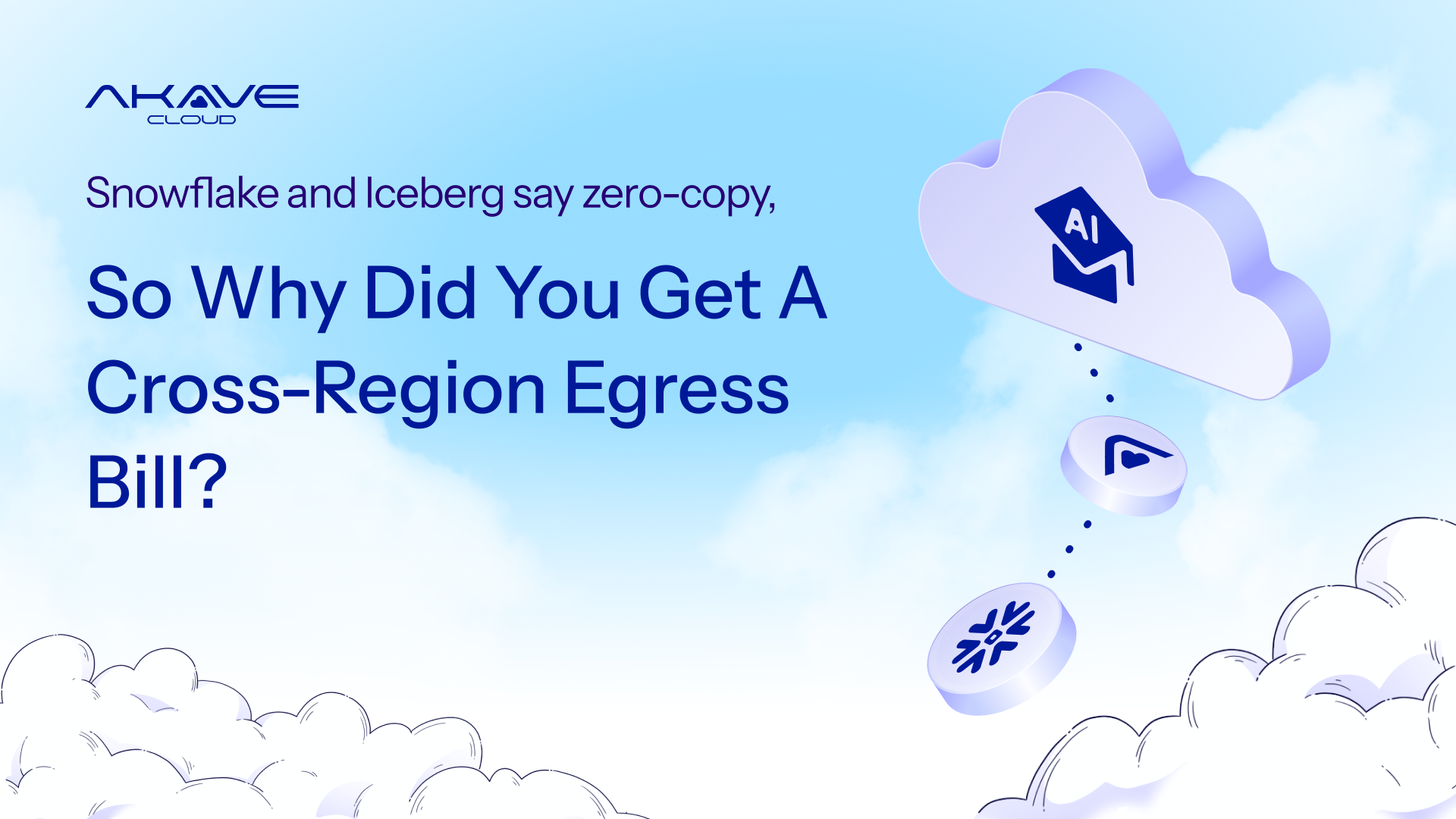
Snowflake and Iceberg say zero-copy, so why did You get a cross-region egress bill?
Zero-copy and zero-egress are different promises. Zero-copy means no data duplication into a second proprietary format. Zero-egress means the storage layer doesn't meter data movement. A Snowflake-native team running cross-region Iceberg reads hits the duplication-tax-to-zero/movement-tax-not-zero gap as a five-figure surprise line item. The fix lives in the storage layer, not the contract.
Why Every Neocloud Deployment Needs a Persistent Object Storage That Isn't AWS
You signed CoreWeave or Lambda for the GPU economics. Six months later your AWS bill hasn't moved because the training data is still on S3. A 50TB dataset read four times a month is roughly $13,800 in egress alone, eating the GPU savings line by line. Compute-agnostic storage is the structural fix, not a partner-network exemption.

Wasabi vs Backblaze B2 vs Akave Cloud: How the July 2026 Pricing Hikes Changes Backup Math
Wasabi raised PAYG to $7.99/TB on July 1, 2026. Backblaze B2 moved to $6.95/TB on May 1. Akave Cloud Standard, the backup tier, sits at $5.99/TB with 3× free egress. At 100TB retained, that spread is $2,400/year less than Wasabi and $1,152/year less than Backblaze, before any verification or compliance considerations.

Cloud Storage Pricing 2026: The Reversal Is Structural
The era of perpetually declining cloud storage pricing, a 15-year trend finance teams treated as a natural law, ended in 2025. Three named 2026 price moves are now on the record: Wasabi raised PAYG to $7.99/TB on July 1, Backblaze B2 to $6.95/TB on May 1, and Pure Storage's CEO disclosed a ~70% customer price rise on input costs up 300–900%. The driver is structural. AI-driven HBM demand has reallocated wafer capacity across the memory and storage supply chain, holding component prices elevated through 2027. The 2026 procurement math doesn't match the 2024 budget decks.

The Real Physical AI Moat Isn't the Robot. It's the Data It Collects.
The robotics company had the data. The foundation model lab had the money. One question killed the deal: "Can you prove this data is what you say it is?" Data stored in an S3 bucket with timestamps in a database the same team administers has no independent chain of custody. The datasets being collected today are the inventory available in 12–24 months. The provenance window is now.
.webp)
Google Cloud Is Doubling Its Peering Egress Rates on May 1 - Here's What That Means for Your Cloud Storage Cost.
On May 1, 2026, Google Cloud automatically doubles CDN Interconnect egress rates in North America, with no opt-out for teams using Cloudflare, Akamai, or Fastly as their CDN origin. This post breaks down which GCP egress products are affected, models the exact before/after monthly cost for a representative AI startup workload, and calculates what the same data volume costs on zero-egress object storage instead. Read it before your first higher invoice arrives.

Intuizi Cut Storage Costs 50%+ with Akave on Avalanche
50%+ lower storage costs. Zero egress fees. 60% faster analytics. Intuizi migrated to Akave Cloud with Snowflake querying Iceberg tables—existing Parquet structures and pipelines unchanged.
How to Cut Your Snowflake Bill by 15% or More
Snowflake external tables + Akave O3: hot data stays in Snowflake, warm and cold data moves to $14.99/TB storage with zero egress fees. No ETL changes, no code changes, no workflow disruption.
Snowflake + Akave: What to Show Your GDPR Auditor Besides Screenshots
Snowflake external stages with Akave generate blockchain-anchored jurisdiction receipts—tamper-evident, independently verifiable evidence auditors can query without trusting vendor logs.
Cloud Egress Fees Explained: Azure vs Google Cloud vs Akave
Azure egress fees start at $0.087/GB. GCP starts at $0.12/GB. Both providers charge 5–6x more to move data than to store it. This comparison covers real workload costs across three scenarios: AI analytics pipelines, backup restore testing, and enterprise data operations, with side-by-side numbers for Azure Blob Storage, Google Cloud Storage, and Akave Cloud's zero-egress fees flat-rate model at 100 TB, 1 PB, and 10 PB scale.
How Intuizi Modernized Its Marketing AI Data Platform and Reduced Costs by Over 50% with Snowflake and Akave
As Intuizi's data lake grew to multi-petabyte scale, query costs rose and metadata management became a bottleneck. The solution: Snowflake for analytics, Akave Cloud for Iceberg-optimized storage. The result was a modern lakehouse architecture with 50% lower costs, 60% faster turnaround, and no pipeline rearchitecture required.
Snowflake External Stages and Backup Resilience: What Enterprises Need to Know
S3 Object Lock prevents accidental deletion. It doesn't prove backup integrity to auditors. Blockchain-anchored verification for Snowflake external stages delivers continuous, cryptographic proof for NIS2/DORA/SEC compliance.
Akash Network & Akave: Building the First Sovereign AI Infrastructure
Akash Network integrates with Akave to deliver sovereign AI infrastructure, decentralized GPU compute at 70% lower cost, S3-compatible storage with zero egress fees, and onchain verification for every artifact.
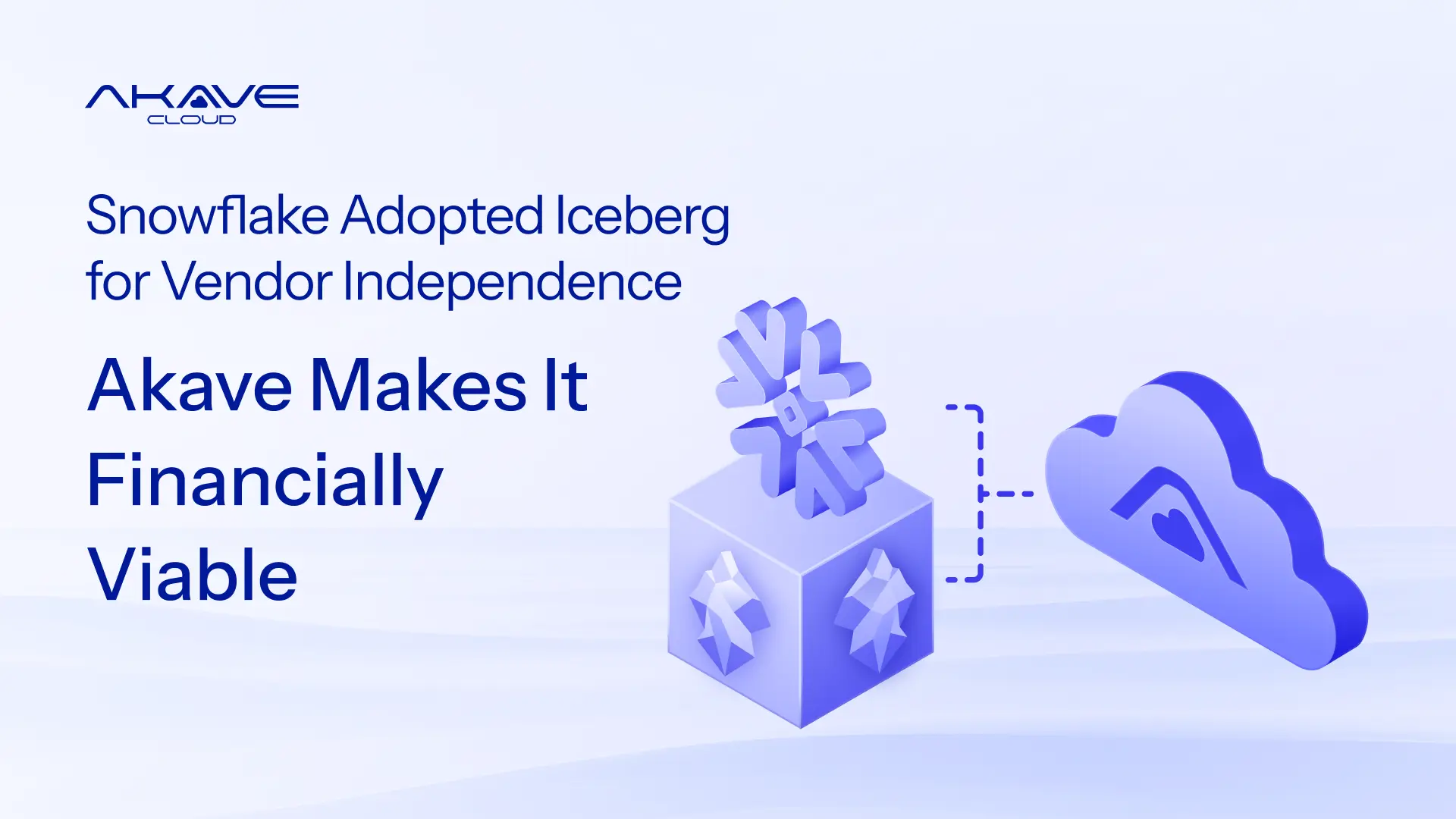
Snowflake Adopted Iceberg for Vendor Independence - Akave Makes It Financially Viable
Store data in Iceberg format on S3. Query with Snowflake today. Retain ability to query with Spark or Trino tomorrow. Architects want multi-engine access - Snowflake for BI, Spark for ETL, Trino for ad-hoc queries. Same data. Different engines. No vendor dependence Apache Iceberg gives Snowflake users the ability to store data in external object storage - theoretically achieving vendor independence. But storing Iceberg tables on Azure Blob or Google Cloud still generates egress fees ($0.087–$0.12/GB) every time Snowflake queries that external data. Akave Cloud provides S3-compatible external storage at $14.99/TiB with $0 egress, making Snowflake + Iceberg vendor independence financially viable rather than cost-neutral
How to Run Snowflake Cortex AI Training Without Egress Fees(Using Akave)?
Snowflake Cortex training costs can rise when datasets repeatedly move between Snowflake and external storage during feature prep, checkpointing, validation, and retraining. You reduce avoidable movement by using an external stage architecture where training data is read from a controlled object-store layer and movement paths are explicitly governed, monitored, and minimized.
.webp)
When Models Commoditize, Data Pipelines Decide Who Wins
GPT-4o's price dropped 83% in 16 months. According to Menlo Ventures' 2025 LLM Market Update, OpenAI's enterprise market share fell from over 50% to 25%, with Anthropic now leading at 32%.
The model wars produced a clear winner: commoditization itself. GPT-5.1, Claude Opus 4.5, Llama 4 Maverick, Gemini 2.0. Comparable capabilities, converging benchmarks, aggressive pricing.
De blinde vlek van FinOps: 32% cloudafval dat u niet kunt zien
Je hebt een FinOps-platform geïmplementeerd. Je bronnen getagd. Voer wekelijkse kostenbeoordelingen uit. En 32% van je clouduitgaven wordt nog steeds verspild. Uit de State of the Cloud-enquête van Flexera in 2022 onder meer dan 750 bedrijven bleek dat dit het gemiddelde is. En het stijgt: 30% in 2021, 32% in 2022. Het probleem is niet de inspanning, maar wat je optimaliseert.

De herkomst van gegevens is niet meer optioneel: wat de naleving van de EU-AI-wet eigenlijk vereist
Uw juridische team vraagt om een bewijs van de oorsprong van de trainingsgegevens. Je haalt CloudTrail-logboeken op. De raadsman van de tegenpartij vraagt: „Kan AWS deze logboeken wijzigen?” Het antwoord is ja. De vraag is of dat belangrijk is, en in toenemende mate ook.
Back-ups zijn geen bewijs: waarom regelgevers nu verifieerbare herstelbaarheid eisen
Uw reservekopietaak is met succes voltooid. Je auditor maakt het niet uit.
58% van de gegevensback-ups mislukt tijdens daadwerkelijke herstelpogingen. 40% van de cyberverzekeringsclaims die in 2024 werden ingediend, werd afgewezen. Niet omdat de aanvallen niet echt waren. Niet omdat de schade niet werd gedekt. Omdat bedrijven niet konden bewijzen dat hun back-ups echt werken.
Zelf gehoste cloudopslag: het meest geloofwaardige antwoord op blootstelling aan de CLOUD Act
Verplaats je gegevens naar Frankfurt. Nog steeds onderworpen aan de Amerikaanse wetgeving. Ga over naar OVHcloud. Nog steeds onderworpen aan de Franse wet. Het debat over gegevenssoevereiniteit heeft de verkeerde vraag gesteld. Iedereen maakt ruzie over waar data zich bevindt. De echte vraag is wie de voogdij heeft.
Technische update van november: Asynchrone I/O, console-first O3 en duurzaamheid met PDP-ondersteuning
In november zijn O3 en de Akave-protocolstack veranderd in iets dat je op grote schaal als primaire opslag kunt beschouwen. We hebben drie O3-releases verzonden (v1.4.0, v1.4.1, v1.4.2) en de protocollijn doorgeschakeld naar Akave v0.4.0/v0.4.1.
October Engineering Update: O3 Gets Faster, Leaner, and More Operator-Friendly
October pushed O3 deeper into enterprise territory. We shipped two releases, O3 v1.3.0 and the AkaveSDK v0.3.1 (protocol) adding full cache-management, kernel-accelerated file paths, AWS-accurate pagination, hardened metadata encryption, and a CLI-based ACME flow for bucket certificates.
How to Use Akave Cloud's Decentralized Object Storage with CloudMounter | For S3 Compatible Storage
In this short demo, we will walk you through how to connect Akave Cloud to CloudMounter, a desktop app that lets you mount cloud storage as a local drive on your computer.
Akave Cloud Now Offers Verifiable Backup Storage Powered by Filecoin Onchain Cloud
Institutions and builders have come to expect tiered storage options similar to those offered by hyperscalers. Akave’s mission is to bring that same flexibility to decentralized storage, by offering S3-compatible access and onchain verifiability without compromising cost, speed, or performance.
How to Use Akave Cloud with Snowflake External Tables?
This guide walks through how to connect your existing Snowflake account to an Akave Cloud instance, a more cost-efficient, verifiable, and open alternative to AWS S3.
How to Migrate Data from AWS S3 to Akave Cloud Using Rclone (Step-by-Step Guide)
The integration provides a quick way to move or sync your data from major cloud providers (AWS, GCP, Azure) into Akave’s verifiable, decentralized, and cost-efficient object storage.

MinIO’s Shift to Source-Only: How to Migrate to S3-Compatible, Verifiable Storage with Akave O3
MinIO’s recent move to source-only distribution and feature gating has left teams scrambling for alternatives. Akave O3 offers a stable, S3-compatible solution with signed builds, enterprise-grade governance, and zero egress pricing,giving teams a future-proof path without the lock-in or surprise tradeoffs.
%20.webp)
September Engineering Update: Making Akave Cloud O3 Enterprise-Grade (and friendlier)
September was a shipping month. We landed three O3 releases (v1.2.0, v1.2.1, v1.3.0), pushed key protocol changes toward verifiable, repairable data at scale with PDP integration, and moved our O3 Trustless GUI (“Prickly Pear”) from wireframes into a working app. Here’s the full rundown

The October 2025 AWS Outage: Lessons in Cloud Concentration, Resilience, and the Need for Decentralization
A case study of the October 20, 2025 Amazon Web Services outage in US‑EAST‑1. This analysis looks at what caused the disruption, which services were affected, and why a single provider’s failure ripples across the globe. It also explores the implications for cloud resilience, digital sovereignty and the future of decentralised infrastructure.
Composable Infrastructure: The Next Evolution of Enterprise Cloud Architecture
By 2026, enterprise cloud strategy is shifting from monolithic stacks to composable infrastructure—modular, interoperable systems built on open standards. Instead of being locked into a single vendor, companies combine specialized tools like Snowflake for analytics, Apache Iceberg for open data formats, and Akave Cloud for verifiable storage.
5 Trends Shaping the Future of Cloud Storage and AI Infrastructure in 2026
The five cloud storage trends defining enterprise infrastructure in 2026 are: (1) zero-egress architectures eliminating the 4.8–6× cost penalty of moving data; (2) verifiable data provenance mandated by the EU AI Act for high-risk AI systems; (3) AI-native storage optimised for model training and agentic pipelines; (4) European data sovereignty driven by CLOUD Act legal exposure; and (5) DePIN networks achieving enterprise-grade cryptographic durability without hyperscaler dependency. Akave Cloud is built around all five.
AWS S3 vs Akave Cloud | Zero Egress & Verifiable Storage
AWS S3 and Akave Cloud both offer S3-compatible object storage - meaning any application built for AWS S3 works with Akave Cloud without code changes. The critical difference: AWS charges approximately $0.09/GB in egress fees (verify at aws.amazon.com/s3/pricing). Akave Cloud charges $0 under its flat-rate $14.99/TiB model. For a 50TB workload with 20TB monthly egress, that's a difference of $22,792/year in data movement charges alone
.webp)
From Locked Data to AI-Ready Infrastructure: How Enterprises Can Win the Next Data Race?
Most enterprise data remains underutilized, trapped in silos, weighed down by egress fees, and unfit for real-time AI workflows. Akave Cloud is a programmable, verifiable object storage layer built to change that. With S3 compatibility, zero egress fees, and onchain auditability, it helps enterprises unlock proprietary data, support AI-scale performance, and monetize datasets via emerging data marketplaces like Baselight. From synthetic data storage to regulatory readiness, Akave Cloud provides the foundation for data ownership at scale, turning compliance cost centers into revenue-generating assets.

A Practical Guide to Data Governance with Akave O3 - GDPR to SOC 2, Done Right
Akave O3 provides enterprises and institutions with GDPR-compliant cloud storage that combines S3 compatibility, immutable audit trails, encryption, and policy-based governance. Designed for regulated industries, O3 enables organizations to meet GDPR, HIPAA, SOC 2, and ISO 27001 requirements with verifiable provenance and zero egress fees. By embedding governance into the storage layer—covering access control, retention, classification, and auditability—Akave O3 helps data leaders transform compliance from a burden into a competitive advantage.
Akave Cloud × Heurist: Verifiable Storage on Blockchain for the Agentic AI Cloud
TL;DR Centralized AI cloud creates three predictable problems; exponential cost, vendor lock-in, and compliance risk. Akave Cloud × Heurist solves this by combining verifiable, S3-compatible storage with decentralized compute and ZK-native micropayments. The result: resilient, sovereign infrastructure that preserves provenance, reduces costs, and powers the agentic AI economy, where autonomous agents can store, share, and transact data with cryptographic guarantees.
Preserving Independent Journalism: The Defiant Secures Its Archives with Akave Cloud + Filecoin
The Defiant is securing its archives with Akave Cloud + Filecoin, making every article immutable, verifiable, and tamper-proof. Content is encrypted, content-addressed, and backed by decentralized storage for long-term durability. This sets a new standard for trustworthy journalism with onchain audit trails and S3 compatibility.

Akave Cloud x Snowflake: The First Decentralized Object Storage Integration for AI and Analytics
Enterprise data architecture is undergoing fundamental transformation. The convergence of explosive data growth, escalating storage costs, and increasing demands for infrastructure flexibility is exposing critical weaknesses in traditional cloud storage models. While Snowflake has emerged as the dominant enterprise data platform, powering sophisticated analytics, AI capabilities, and machine learning workflows, organizations still struggle with the fundamental storage layer beneath it.
No More Egress Fees: How Akave Cloud Simplifies Cloud Storage
Egress fees are per-GB charges that cloud providers levy when data exits their network. Azure charges $0.087/GB - 4.8× more than its $0.018/GB storage rate. Google Cloud charges $0.12/GB for the first 1TB - 6× its storage rate. For a workload storing 50TB and moving 20TB/month, egress adds $1,731/month on Azure and $1,926/month on Google Cloud - costs that don't exist on Akave Cloud's zero-egress flat-rate model ($14.99/TiB)
.webp)
Rethinking Content Addressing: Introducing Akave’s eCID - Encrypted, Verifiable, and Enterprise-Ready
In the era of data breaches, deepfakes, ransomware, and sophisticated supply chain attacks, verifying the integrity and origin of data has never been more critical. Akave is proud to introduce a next-generation content identification paradigm: the eCID.
Akave Q2 2025 Update: From O3 Gateway to Akave Cloud: Next Layer of Sovereign Data Infrastructure
From April to July, we didn’t just ship product, we laid the architecture for a new kind of internet. One where data is sovereign, verifiable, and programmable. At Akave, our mission is simple: to enable a world where all assets live on‑chain and humanity’s advancement is accelerated by the power of data. Our vision is a future where every transaction is verifiable, transparent, and built on sovereign infrastructure, unlocking innovation across AI and beyond. This past quarter, that vision moved from blueprint to reality.
Akave Cloud x Filecoin: The Future of Verifiable, Decentralized Object Storage
The explosion of AI workloads and decentralized computing has highlighted the need for large-scale, verifiable data architectures. Rising to this demand, Akave Cloud delivers a decentralized storage layer with everything teams need to store, manage, and access data at scale: S3 compatibility, onchain access control, and verifiable storage, backed by the Filecoin network.

Akave lanceert de eerste gedecentraliseerde datalaag op Avalanche L1 - Programmeerbare, verifieerbare opslag voor AI en bedrijven
Akave ontsluit gedecentraliseerde data op grote schaal: verifieerbaar, onveranderlijk en programmeerbaar. Nu live op Avalanche L1 voor AI-bouwers, bedrijven en betrouwbare systemen.

Introducing Akave Cloud: A New Standard for Verifiable Data Ownership
Akave Cloud launches as the first Avalanche L1-based storage platform—offering S3 compatibility, onchain control, and verifiable, sovereign data access.
Modern Infra. Verifiable By Design.
Whether you're scaling your AI infrastructure, handling sensitive records, or modernizing your cloud stack, Akave Cloud is ready to plug in. It feels familiar, but works fundamentally better.