



A VP of Infrastructure at a US bank with EU operations signs a neocloud contract for GPU capacity.
The model trains. The economics work. Then legal reviews the deal and asks two questions the procurement team can't answer:
- If a foreign authority compels the provider, what gets handed over?
- How do we prove our training data was never readable by another tenant on the same shared infrastructure?
The answers come back as assurances, not evidence. The deal stalls.
You can test what auditable, tenant-isolated storage looks like on your own data with a free trial, but the architectural gap is worth understanding first, because it's the gap that's about to define enterprise neocloud procurement. Closing it is what Sovereign AI Storage Infrastructure is for.
CoreWeave Joins the Nasdaq-100, and Enterprise Procurement Asks Different Questions
As CoreWeave joins the Nasdaq-100 on June 22, 2026, the signal is bigger than one company's index membership. It marks the moment neocloud stops being a place startups rent spare GPUs and becomes infrastructure that institutional enterprise procurement takes seriously. Banks, insurers, defense contractors, and regulated health platforms are now evaluating neocloud the way they evaluate any vendor that touches sensitive data.
That changes the buying conversation. GPU price per hour and time-to-cluster used to win deals. They still matter. But institutional procurement runs a different gauntlet: legal review, data protection officers, audit committees. Those teams ask who can be compelled to access the data, and how isolation is proven under scrutiny.
The neocloud stack was built to answer the first set of questions. The compute layer is excellent. The neocloud object storage layer, where the training data actually lives, was not built to answer the second set. Two specific failures surface immediately: CLOUD Act exposure on the legal side, and unprovable multi-tenant separation on the architectural side. Both sit in storage, not compute.
Multi-Tenant GPU Clouds: How Do You Prove Your Training Data Never Touched Another Tenant's?
Neocloud is multi-tenant by design. That's how the economics work: shared backend infrastructure spreads fixed cost across many customers, which is exactly why the GPU pricing is competitive. The enterprise buyer isn't objecting to multi-tenancy. The buyer is asking a question multi-tenancy usually can't answer with evidence.
When your training data and another tenant's data share backend storage, "they're logically separated" is a design assertion. It describes intent. An auditor doesn't accept intent. The auditor asks for proof that your data was isolated, proof of who accessed it and when, and proof that when you deleted it, deletion actually happened rather than the pointer being removed while the bytes lingered on shared media.
Most shared-storage architectures answer these with logs the provider controls and could, in principle, edit. A log of access that the storage operator can rewrite is a promise, not evidence. For an AI training workload, where the data is often the regulated asset and the model derived from it inherits the data's compliance obligations, that gap follows the model downstream. You can't prove the provenance of a model if you can't prove the isolation of the data it trained on.
So the procurement question sharpens to something specific. Our GPU provider is multi-tenant. How do we know our training data was isolated from every other tenant, and how do we prove it when we're audited?
An architecture that can only answer with assurances loses the deal at legal review.
Provable Isolation: Siloed Endpoints, Shared Backend, Auditable Deletion
This is where the architecture has to do work that policy can't. Akave lets you create multiple siloed, S3-compatible endpoints that share backend storage infrastructure. Separate endpoints per customer, one shared backend. You keep the multi-tenant economics that make neocloud viable, without collapsing into the unprovable separation that breaks the audit.
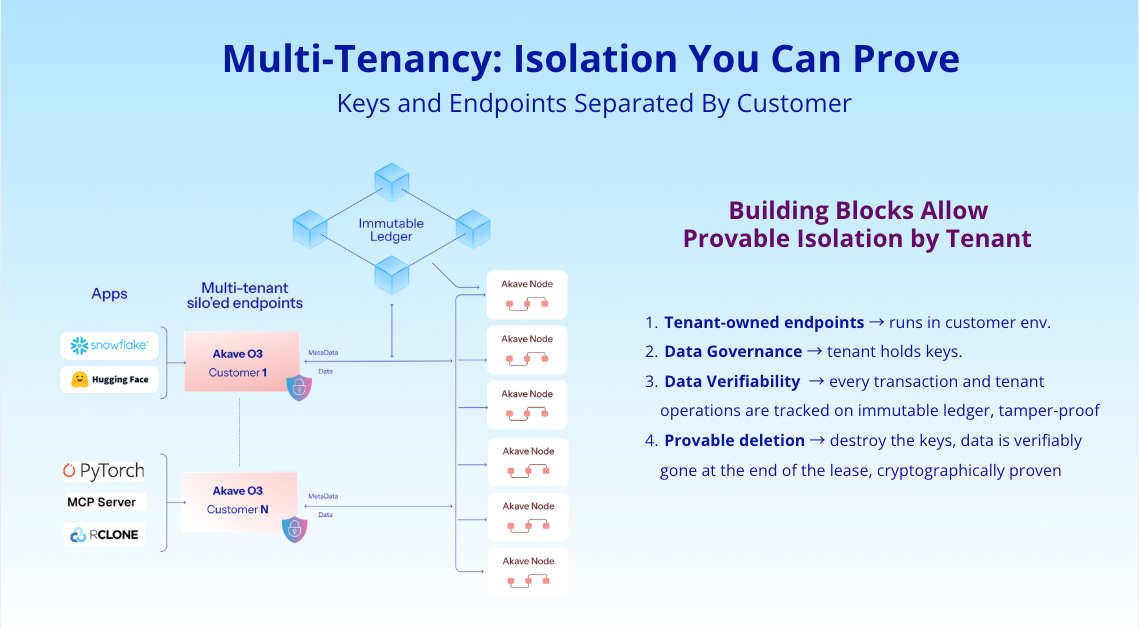
Four building blocks make the isolation provable rather than asserted.
- Tenant-owned endpoints. Each tenant's endpoint runs in the customer environment as its own isolated surface, not a shared API gateway with logical partitions behind it.
- Tenant-held keys. The tenant holds the encryption keys through Bring Your Own Key and Hold Your Own Key (BYOK / HYOK) support. The backend stores encrypted data it cannot read. The separation is cryptographic.
- Ledger-tracked operations. Every transaction and tenant operation is recorded on the immutable storage ledger. Access, modification, and movement are tracked on an append-only record the storage operator cannot quietly rewrite. This is the difference between an audit log and auditable evidence.
- Provable deletion. Deletion is enforced by destroying the keys. When the keys are gone, the data is cryptographically proven to be gone, not pointer-removed while the bytes survive on shared media. At end of lease, the auditor gets proof, not a screenshot of a delete confirmation.
Put together, these turn the auditor's three questions into answers backed by evidence. Was my data isolated from other tenants? Yes, cryptographically, with tenant-held keys on a separate endpoint. Who accessed it and when? Read it off the ledger; any modification to that record is independently detectable. Did deletion happen? The keys were destroyed, and that's cryptographically proven. That's the property a shared-backend log can't deliver.
Sovereign AI Storage Infrastructure: The Auditable Layer That Closes the NeoCloud Gap
What the neocloud stack is missing isn't more compute or cheaper GPUs. It's a storage layer that answers legal and audit questions with evidence instead of assurances. That layer is Sovereign AI Storage Infrastructure: a net-new category that combines auditable data integrity, jurisdiction-aware storage, and zero-egress economics into one S3-compatible platform.
It rests on three properties working together. Jurisdiction-aware placement lets you store where the law allows, query from anywhere, so EU customer data stays under EU control while the model trains wherever the GPUs are. Auditable integrity means any modification to your data or the record of access to it is independently detectable, which turns isolation and deletion from claims into proof. And zero-egress economics matter more than they look: AI training reads the same data thousands of times across iterations, and at $14.99/TB flat-rate, zero egress, the storage layer doesn't tax every training cycle the way egress-metered hyperscaler storage does. Provable separation that's also economically punishing to read doesn't survive contact with a real training budget.
The S3 compatibility is what makes this deployable rather than theoretical. It's a drop-in replacement for existing S3 workflows, so the storage layer changes underneath the training pipeline without re-architecting it. The GPUs stay where they are. The data gets a sovereign, auditable foundation underneath.
For the VP of Infrastructure who stalled at legal review, the conversation changes. When the data protection officer asks whether a foreign authority can compel readable data, the answer is no, because the provider never holds it readable. When the auditor asks whether training data was isolated and whether deletion happened, the answer is yes, and here's the proof. The procurement question that used to stall the deal becomes the reason the deal closes.
The neocloud era is going institutional. The compute is ready. The question is whether your storage can be compelled, or proven.
See how the auditable storage layer fits AI training workloads on the AI & ML workloads page, and review how teams have anchored data under their own control in the case studies. When you're ready to test isolation on your own data, the free trial runs against real workloads.
FAQ
Does the CLOUD Act apply to a US neocloud provider storing my data in the EU?
Yes. The CLOUD Act lets US authorities compel US-headquartered companies to disclose data they hold regardless of where it's physically stored. An EU region setting doesn't move the data outside US legal reach if the provider is a US corporation. What limits exposure is an architecture where the provider never holds your data in readable form and never holds your keys.
How do I prove my training data was isolated from other tenants on shared infrastructure?
With tenant-owned S3-compatible endpoints, tenant-held encryption keys, and an immutable storage ledger that records every operation. Isolation becomes cryptographic rather than a logical partition, and the access record is append-only, so any modification to it is independently detectable. The auditor gets evidence instead of an assurance.
What does "provable deletion" mean in a multi-tenant storage system?
Deletion is enforced by destroying the encryption keys. Once the keys are gone, the data is cryptographically proven to be unrecoverable, rather than the pointer being removed while the underlying bytes remain on shared media. At end of lease, that produces audit-ready proof of deletion.
Is Sovereign AI Storage Infrastructure compatible with my existing training pipeline?
Yes. It's S3-compatible and works as a drop-in replacement for existing S3 workflows, so the storage layer changes underneath the pipeline without re-architecting compute. Your GPU provider stays the same; the data gets an auditable, jurisdiction-aware foundation underneath it.
Why does zero egress matter for AI training storage specifically?
AI training reads the same datasets repeatedly across iterations. Egress-metered storage taxes every one of those reads, which makes a provably isolated storage layer economically unworkable at training scale. At $14.99/TB flat-rate, zero egress, the storage layer supports repeated reads without a per-read penalty.