

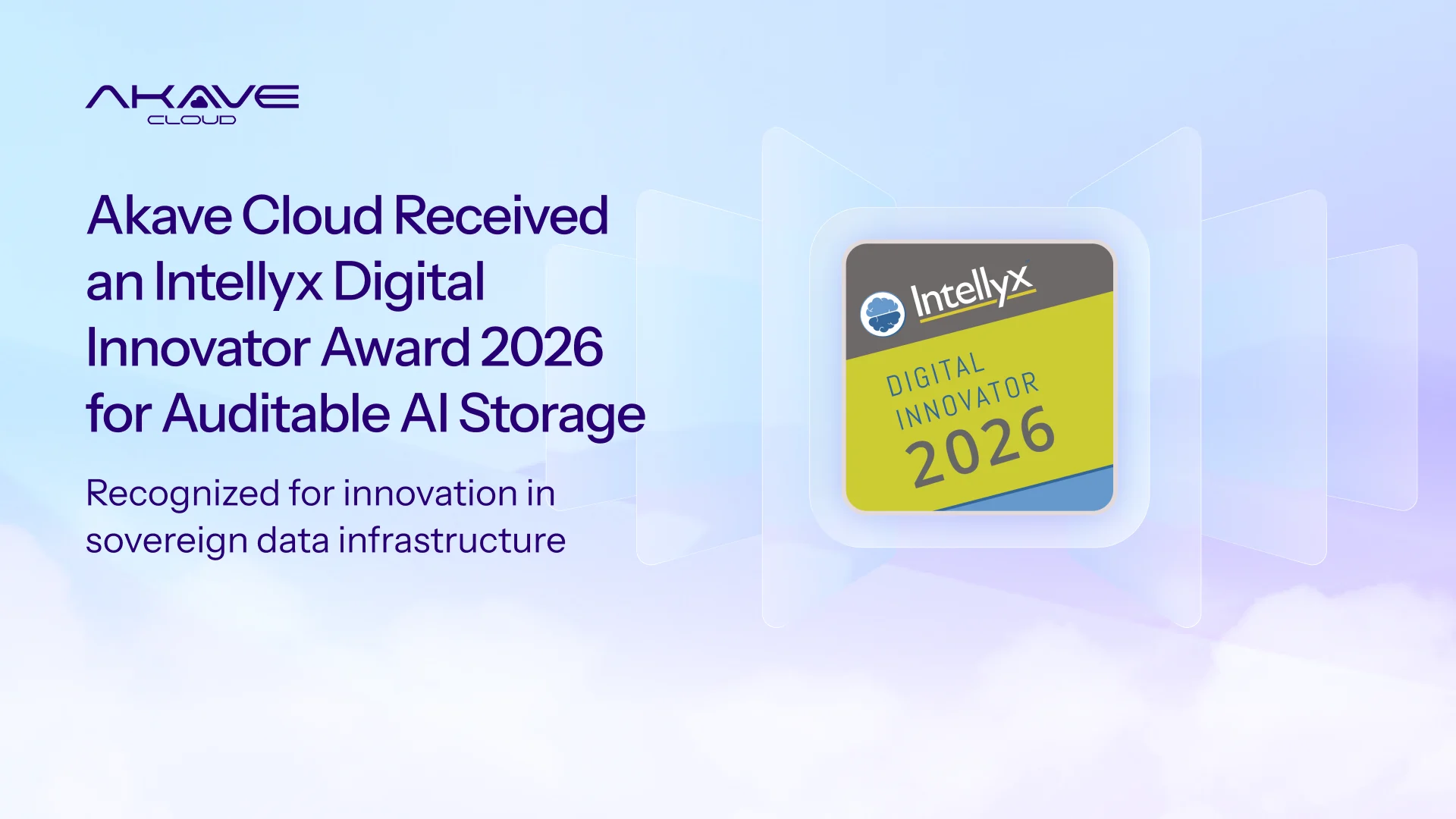
AI doesn't just need more storage. It needs storage that can defend against any audit. Most teams can show you their data; far fewer can prove its history, that no one altered a byte since it was written and that it stayed inside the jurisdiction they committed to. That gap is why an enterprise analyst firm spent time on the storage layer this year, and why Intellyx has named Akave Cloud a 2026 Digital Innovator. This is the argument behind the recognition: Sovereign AI Storage Infrastructure, built so that any modification is independently detectable.
Most teams have the data. They can't independently prove what it is or where it has lived. When an AI output is later disputed, the question moves upstream, fast, to that data. You can test what auditable storage looks like on your own data on the free trial, but the gap is worth understanding first.
The award itself is narrow and worth stating plainly. Intellyx recognizes vendors that complete a successful analyst briefing resulting in coverage. Akave is not an Intellyx customer, and no fee changed hands. We read it as a signal that storage, long treated as undifferentiated plumbing, is becoming where AI trust and AI sovereignty are won or lost.
Why object storage was treated as a commodity?
For a decade the conventional wisdom was sound. Object storage held bytes you would read back later. One provider's gigabyte was interchangeable with another's, so the rational way to choose was price and durability. Storage was a line item, not an architecture decision.
That logic holds when data is passive. It breaks the moment data becomes evidence.
What does AI infrastructure demand that traditional storage doesn't?
AI changes what data is. A training set, a model checkpoint, a retrieval corpus, an agent's decision log: these aren't bytes you'll casually read back. They are the record you'll be asked to defend. The defensibility of any AI output is bounded by the defensibility of its inputs, which is why dedicated data-auditing functions now vet datasets before training begins.
Auditable storage is object storage where every action, writes, reads, deletions, access grants, is recorded with cryptographic proof at ingestion on an immutable storage ledger, so provenance and integrity can be checked independently rather than taken on faith. Sovereign storage adds the second half: the ability to demonstrate where data physically resides and enforce that boundary, rather than trust a region label on a console. Together that is a different requirement than cheap and durable, and traditional object storage was never built to meet it.
Integrity and residency are now trust problems
Regulation pulls the same way. The EU AI Act requires documented data governance and provenance for high-risk systems under Article 10, while GDPR and national residency rules govern where European data can live. In May 2026, the Council and Parliament reached a provisional agreement under the Digital Omnibus to defer standalone high-risk obligations to December 2, 2027, with product-embedded systems moving to August 2, 2028. That agreement is provisional, so timing may still shift. The direction does not: regulators increasingly expect a defensible evidence trail for training data, kept within a controlled jurisdiction. If your AI roadmap runs through a regulated market, a dedicated call with our sales team is the place to scope that early rather than retrofit it.
Why does zero-egress storage matter for AI pipelines?
AI workloads are read-heavy and iterative. You don't load a dataset once; you sweep it repeatedly across experiments, fine-tunes, and evaluation runs. On a metered-egress model, every iteration is billed, so the bill scales with exactly the activity AI teams do most.
Take a team iterating on 20TB of stored data with 15TB of monthly egress. On a typical metered-egress cloud, that is roughly $471/month storage plus roughly $1,382/month egress, about $1,853/month, near $22,200/year before compute. On Akave Cloud, 20TB at $14.99/TB flat-rate, zero egress is about $300/month, near $3,600/year. The delta is close to $18,600/year for one mid-sized workload, and it widens as iteration increases.
Cost still matters. It is table stakes. The differentiator is auditable, sovereign integrity.
Where Akave Cloud fits
Akave Cloud runs a dedicated immutable storage ledger. Every operation is recorded with cryptographic proof at ingestion, producing auditable records of what happened, when, and by whom, delivered through an S3-compatible, zero-egress interface with up to 11 nines of durability. For standard S3 object-storage patterns, adoption is often an endpoint and credential change; teams using custom IAM logic, KMS-managed keys, or trigger-based workflows should plan those paths separately.
The capability set is three pillars: Cyber Resilient, Sovereign Storage, and Compute Agnostic for AI Workloads. Sovereignty is enforced at the storage layer: data can be geofenced to a defined jurisdiction, so residency is something you demonstrate to an auditor, not a label you take on trust. The principle is simple. Store where the law allows, query from anywhere.
The integrity claim has to survive its own stress test, so here it is plainly. Akave does not ask you to trust Akave. The mechanism is detection, not assertion: any modification to a stored object breaks its cryptographic proof, and that mismatch is independently detectable by an external auditor. We don't claim data can never be altered; we claim alteration cannot go unnoticed. For AI evidence trails, that distinction is the entire point. The fastest way to judge it is to run your own dataset through the auditable, zero-egress layer and check the records yourself, on the free trial.
An award is recognition. On its own it proves little. What it reflects is that an enterprise analyst found the underlying argument credible enough to cover. The product claim stands on the architecture: cryptographic proof at ingestion, enforced residency, and auditable records you can test, the same things a marketing-AI team running Snowflake external tables checks when storage and egress have become the largest line on the cloud bill. If your roadmap runs through AI training or inference at scale, the AI & ML workloads path is where that conversation starts.
FAQ
What is the Intellyx Digital Innovator Award?
A recognition Intellyx, an enterprise analyst firm, gives to vendors that complete a successful analyst briefing resulting in coverage that year. It is not a paid placement, and in Akave's case no compensation was expected or received. Akave Cloud was named a 2026 Digital Innovator in the Spring 2026 cohort.
How do you prove AI training or retrieval data hasn't been tampered with?
You need a storage layer that records each operation with cryptographic proof at ingestion, so any later modification breaks that proof and becomes detectable. Akave Cloud records writes, reads, deletions, and access grants on an immutable storage ledger an external auditor can verify without trusting the provider. The guarantee is detection of tampering, not a claim that data physically cannot be touched.
Can Akave prove where my data lives?
Yes. Data can be geofenced to a defined jurisdiction, and access is governed at the storage layer, so residency is something you demonstrate to an auditor rather than a region label you take on trust. That is what makes the layer suitable for GDPR and EU AI Act exposure where the data actually resides.
Is Akave S3-compatible, and can it drop into an existing AI pipeline?
Yes. Akave Cloud exposes an S3-compatible API, so for standard object-storage patterns the change is often just the endpoint and credentials. Pipelines using custom IAM logic, KMS-managed keys, or trigger-based workflows need separate planning, but the application layer generally doesn't have to be rewritten.
If my cloud storage already has versioning and access logs, why do I need auditable storage?
Versioning and access logs are maintained by the same provider that controls the data, so an auditor still has to trust those logs weren't edited. Auditable storage produces records whose integrity can be checked independently: the proof breaks if anything changes, including the record itself. That is the difference between "we logged it" and "you can verify it without trusting us."
Further Reading
Sources
- Intellyx, "2026 Intellyx Digital Innovator Award Winners Announced," May 27, 2026 (embargoed to June 9, 2026). https://intellyx.com/2026/05/27/2026-intellyx-digital-innovator-award-winners-announced/
- Akave Cloud, product and pricing pages (S3-compatible, zero egress, $14.99/TB flat-rate, up to 11 nines durability, immutable storage ledger). https://akave.com/ and https://akave.com/product
- Council of the EU, "Artificial Intelligence: Council and Parliament agree to simplify and streamline rules," May 7, 2026. https://www.consilium.europa.eu/en/press/press-releases/2026/05/07/artificial-intelligence-council-and-parliament-agree-to-simplify-and-streamline-rules/
- Gibson Dunn, "EU AI Act Omnibus Agreement, Postponed High-Risk Deadlines and Other Key Changes," 2026. https://www.gibsondunn.com/eu-ai-act-omnibus-agreement-postponed-high-risk-deadlines-and-other-key-changes/
- AWS, S3 pricing (standard storage $0.023/GB; data transfer out $0.09/GB), used for the illustrative metered-egress calculation in this post. https://aws.amazon.com/s3/pricing/