


As enterprise data needs evolve—driven by AI workloads, cost optimization, and tightening regulatory demands—choosing the right storage provider has never been more critical.
Amazon S3 has long been the default in object storage. It offers mature infrastructure, broad integrations, and has embedded itself in enterprise IT stacks, but it comes at the cost of legacy cloud economics – opaque costs, high egress fees, and vendor lock-in. For teams already locked into AWS, S3 remains the safe incumbent. For everyone else, it’s a legacy model that increasingly feels misaligned with the needs of modern, AI-driven enterprises.
Akave Cloud, by contrast, represents a new approach to cloud object storage, built for a future where data is programmable, verifiable, and decentralized. It combines familiar S3-compatible interfaces with cryptographic audit trails, policy-enforced access, and flat-rate pricing without egress fees. Powered by the Akave Network and integrated with enterprise-grade blockchain infrastructure, Akave Cloud is optimized for modern AI, analytics, and compliance-driven use cases.
This isn’t just a comparison between new and old, it’s a decision between two different philosophies of how storage should work in a world where data is the most valuable enterprise asset.
AWS S3 vs. Akave Cloud Comparison Overview
The Problem with AWS S3 Storage
S3-compatible storage is any object storage system implementing the AWS S3 API specification, allowing S3-built applications to work with alternative providers without code modifications.
Amazon S3 is often marketed as the gold standard for reliability, but behind lies a model optimized for Amazon’s bottom line, not yours:
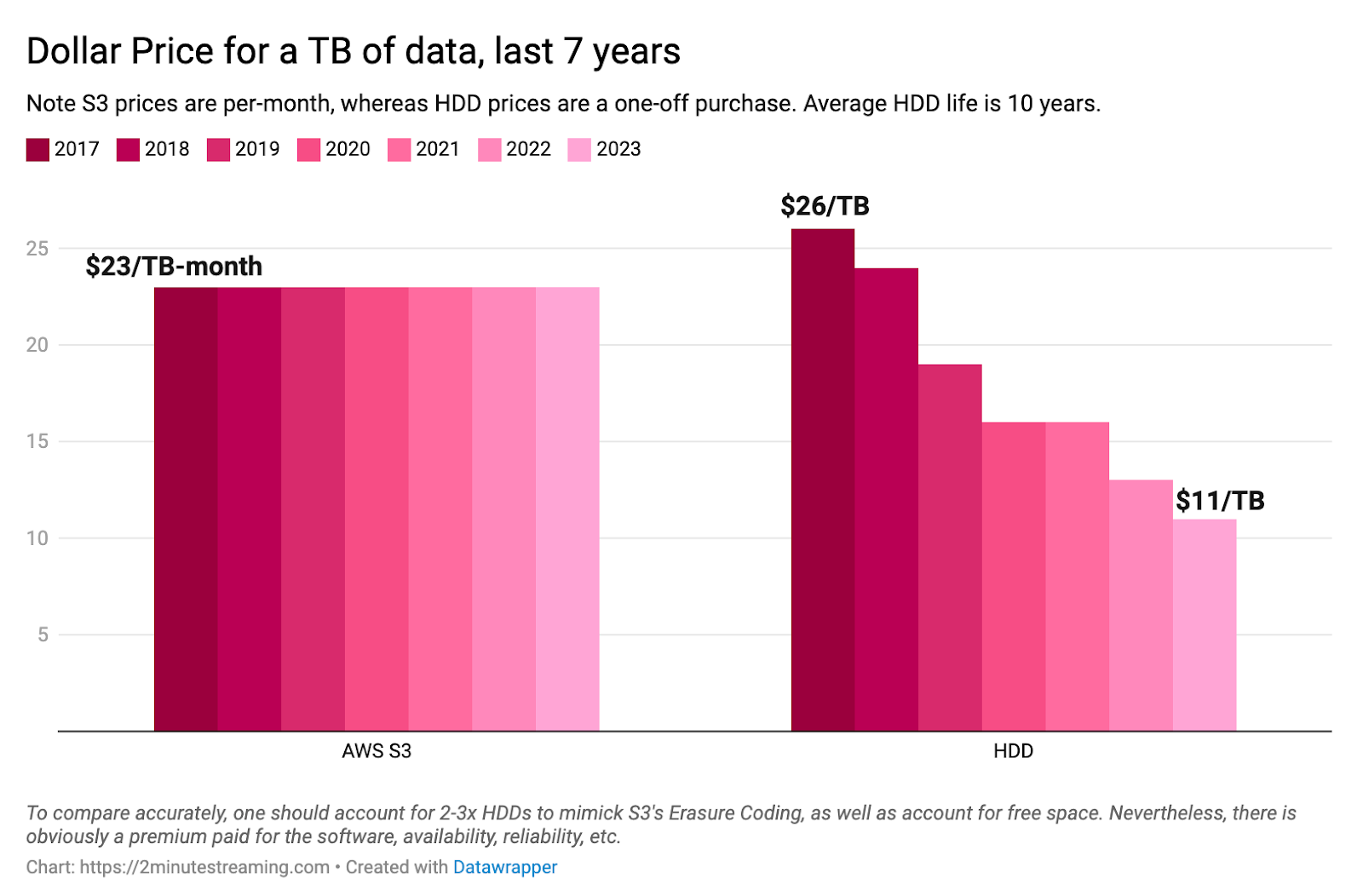
- Legacy Economics: While the cost of storage has gone down by 60-70% over the past eight years, Amazon has not reduced their S3 Standard price by $1. Hidden surcharges create unpredictable bills that balloon with scale.
- Vendor Lock-in: Getting data into AWS is cheap, but getting it out is expensive. High egress fees make it prohibitively expensive to move or monetize datasets, with the cost/TB/month jumping to over $90/TB/month just to retrieve your data once. This isn’t a feature, it’s built by design to keep you locked in.
- Opaque Governance: AWS S3 operates as a black box. Logs and monitoring exist, but enterprises lack verifiable, cryptographic proofs of who accessed what data and when, leaving compliance up to trust, not proof.
- Centralized Risk: S3 ultimately relies on a single cloud provider. Outages in AWS regions have repeatedly shown how centralized dependencies can cascade into global downtime.
Why Akave Cloud Is Different?
Akave Cloud doesn’t just provide storage, it provides a new operating model for enterprise data:
- Predictable Pricing: Flat rate pricing with zero egress fees provides transparent economics at $14.99/TB/month. No hidden fees. No surprise surcharges.
- Immutable & Verifiable by Default: Every read, write, and transformation is logged onchain, creating tamper-proof audit trails for governance and compliance.
- Programmable Access: Smart contracts and policy-based controls let organizations define exactly who, how, and when data can be used.
- Optimized for Modern Workloads: AI, analytics, and decentralized applications run more efficiently when storage is designed around high-throughput ingest, unrestricted data movement, and edge-ready deployment.
- Global Decentralization: Instead of relying on a single provider’s region, Akave spreads resilience across a network – reducing risk, increasing portability, and aligning with data sovereignty requirements.
Pricing Comparison: Predictable vs. Variable
Akave Cloud offers flat-rate pricing starting at $14.99/TB/month, with no egress fees, no request-based surcharges, and transparent costs from day one.
AWS S3, by contrast, charges separately for:
- Storage tier selection (Standard, Infrequent Access, Glacier, etc.)
- API requests (PUT, GET, LIST, etc.)
- Egress fees, which can add up significantly in data-heavy workloads
These egress fees are often one of the largest hidden costs in enterprise cloud storage.
Want to compare costs?
Use these tools to model your actual usage and see the difference in monthly spend.
According to Akave Cloud's Scenario 1 analysis, a 50TB AI analytics workload with 20TB monthly egress costs $31,575/year on Azure and $8,783 on Akave - a 72.2% reduction.' (Akave comparison blog.)
AWS S3 vs. Akave Cloud Core Feature Comparison
Security & Compliance: A Critical Consideration
When evaluating storage platforms, enterprise-grade security and compliance are non-negotiable. Cloud providers like AWS have long-established security programs, global compliance certifications, and dedicated infrastructure to ensure data protection, governance, and threat mitigation at scale.
Akave Cloud, while newer, is designed from the ground up for a zero-trust, verifiable data future, embedding cryptographic proofs and programmable access into the infrastructure itself.
The table below compares data protection, compliance posture, access control, and threat response across AWS S3 and Akave Cloud:
Decision Guide: What Should Your Enterprise Do?
- Run a Proof‑of‑Concept (PoC) comparing cost & performance for your actual data volume + query workload (e.g. Parquet queries, vector searches).
- Map your regulatory & audit requirements: Do you need content‑addressed proofs, legal hold, immutable provenance?
- Estimate total data transfer & egress usage: If your AI pipelines, analytics, or inter‑region work involve moving large datasets, Akave’s zero egress fees can yield large savings.
- Review integration needs: Snowflake, marketplaces, AI agents etc.—do you need plug‑and‑play compatibility?
- Assess support, SLAs & maturity if global reach and latency are critical.
Conclusion
AWS S3 remains a powerful, mature choice, especially for enterprises with existing dependence on AWS, priority on latency, or massive multi‑region requirements.
However, for forward‑thinking organizations pushing AI, data monetization, regulatory risk, and cost optimization, Akave Cloud emerges as a compelling option. With its latest updates, decentralization, verifiable storage, and cost transparency, Akave isn’t just an alternative, it’s potentially better suited for the next generation of data infrastructure.
Related reads:
- How to Migrate Data from AWS S3 to Akave Cloud Using Rclone (Step-by-Step Guide)
- The October 2025 AWS Outage
- Akave Cloud × Baselight: Queryable Data Marketplace
- Akave Cloud: O3 Updates
- Amazon S3 Metadata
- Announcing Amazon S3 Vectors (Preview)
- Akave Cloud x Snowflake Integration
FAQ
Q1: Is Akave Cloud S3-compatible?
A: Yes. Akave Cloud implements the S3-compatible API, meaning standard S3 workflows - PUT, GET, DELETE, LIST, and multipart uploads - work without code changes. To migrate, update your endpoint URL and credentials. If you use advanced features like lifecycle policies, object versioning, or event notifications, test with your specific workload first. (Source: akave.com documentation.)
Q2: What is the cost difference between AWS S3 and Akave Cloud?
A: For a 50TB workload with 20TB monthly egress: AWS S3 costs approximately $31,575/year (using $0.09/GB egress - verify current rate at aws.amazon.com/s3/pricing). Akave Cloud costs $8,783/year at $14.99/TiB flat with $0 egress. The primary cost driver is egress: AWS charges per GB every time data leaves its network; Akave does not.
Q3: How do you migrate from AWS S3 to Akave Cloud?
A: Use rclone, the open-source cloud storage sync tool. Configure Akave as an S3-compatible remote using your Akave endpoint URL and credentials. Run a dry-run (rclone copy --dry-run) to verify scope, execute the full migration (rclone copy), then validate with checksum comparison (rclone check). Update your application's endpoint configuration. No code changes required - only configuration.
Q4: What S3 features does Akave Cloud support?
A: Akave Cloud supports standard S3 operations: PUT, GET, DELETE, LIST, and multipart uploads. For advanced features - lifecycle automation, object versioning, event notifications - test with your specific workload before committing to migration. Verify the current feature list at akave.com/docs.
Q5: Does Akave Cloud charge API fees like AWS S3?
A: No. Akave Cloud charges $0 for API requests. AWS S3 charges per-operation for PUT, COPY, POST, LIST requests ($0.005 per 1,000) and GET requests ($0.0004 per 1,000) - costs that accumulate significantly for data-intensive workloads. Verify current AWS API pricing at aws.amazon.com/s3/pricing.
Connect with Us
Akave Cloud is an enterprise-grade, distributed and scalable object storage designed for large-scale datasets in AI, analytics, and enterprise pipelines. It offers S3 object compatibility, cryptographic verifiability, immutable audit trails, and SDKs for agentic agents; all with zero egress fees and no vendor lock-in saving up to 80% on storage costs vs. hyperscalers.
Akave Cloud works with a wide ecosystem of partners operating hundreds of petabytes of capacity, enabling deployments across multiple countries and powering sovereign data infrastructure. The stack is also pre-qualified with key enterprise apps such as Snowflake and others.