
Soevereine AI
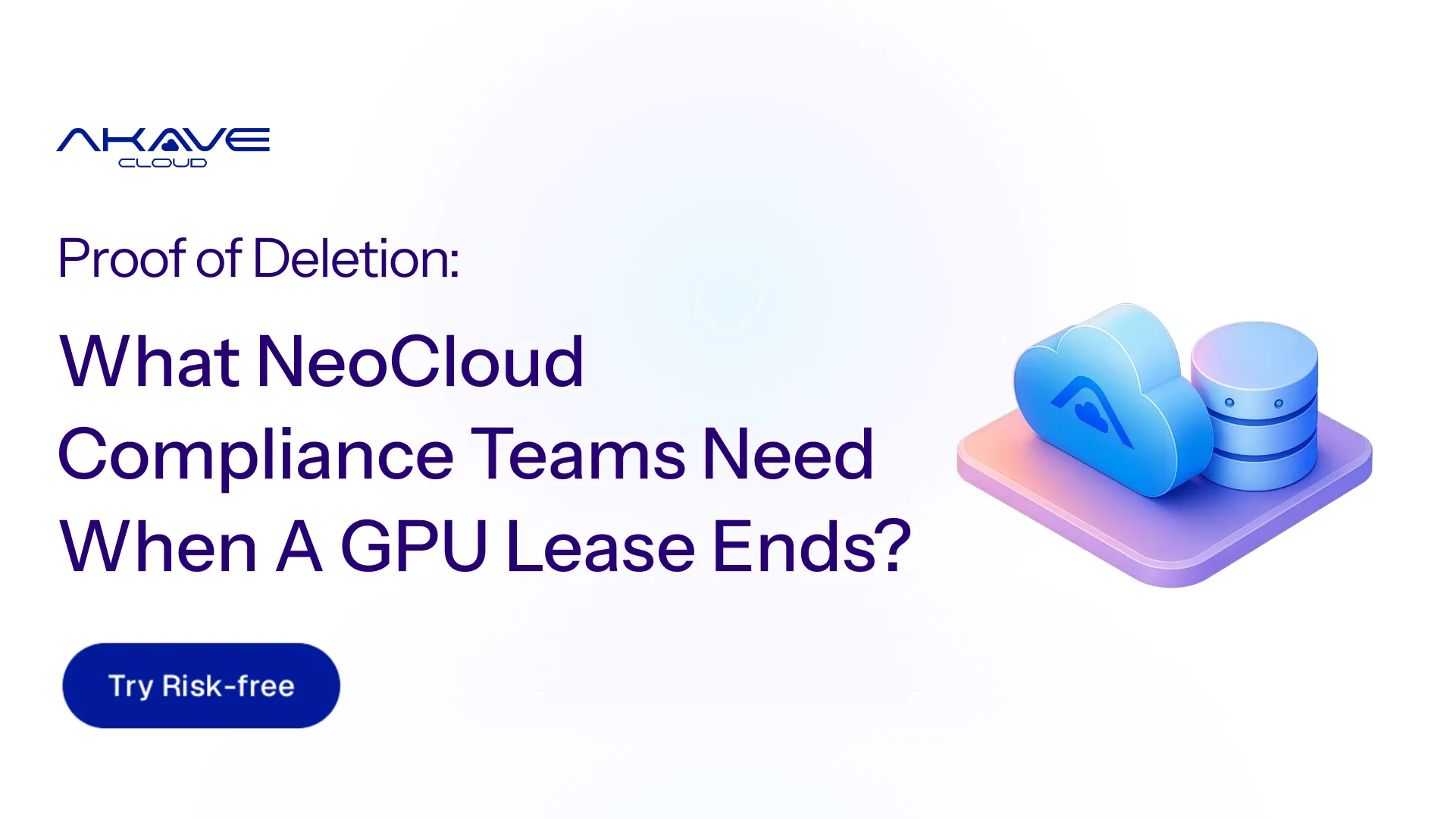
Proof of Deletion: What NeoCloud Compliance Teams Need When a GPU Lease Ends
Not all deletion passes an adversarial audit. A log entry is an assertion. Auditors are moving from self-reported delete logs to independently checkable evidence. This post maps the two mechanisms, key destruction and an independently auditable delete record on an immutable storage ledger and the steps for NeoCloud operators building them in before the next enterprise deal requires it.
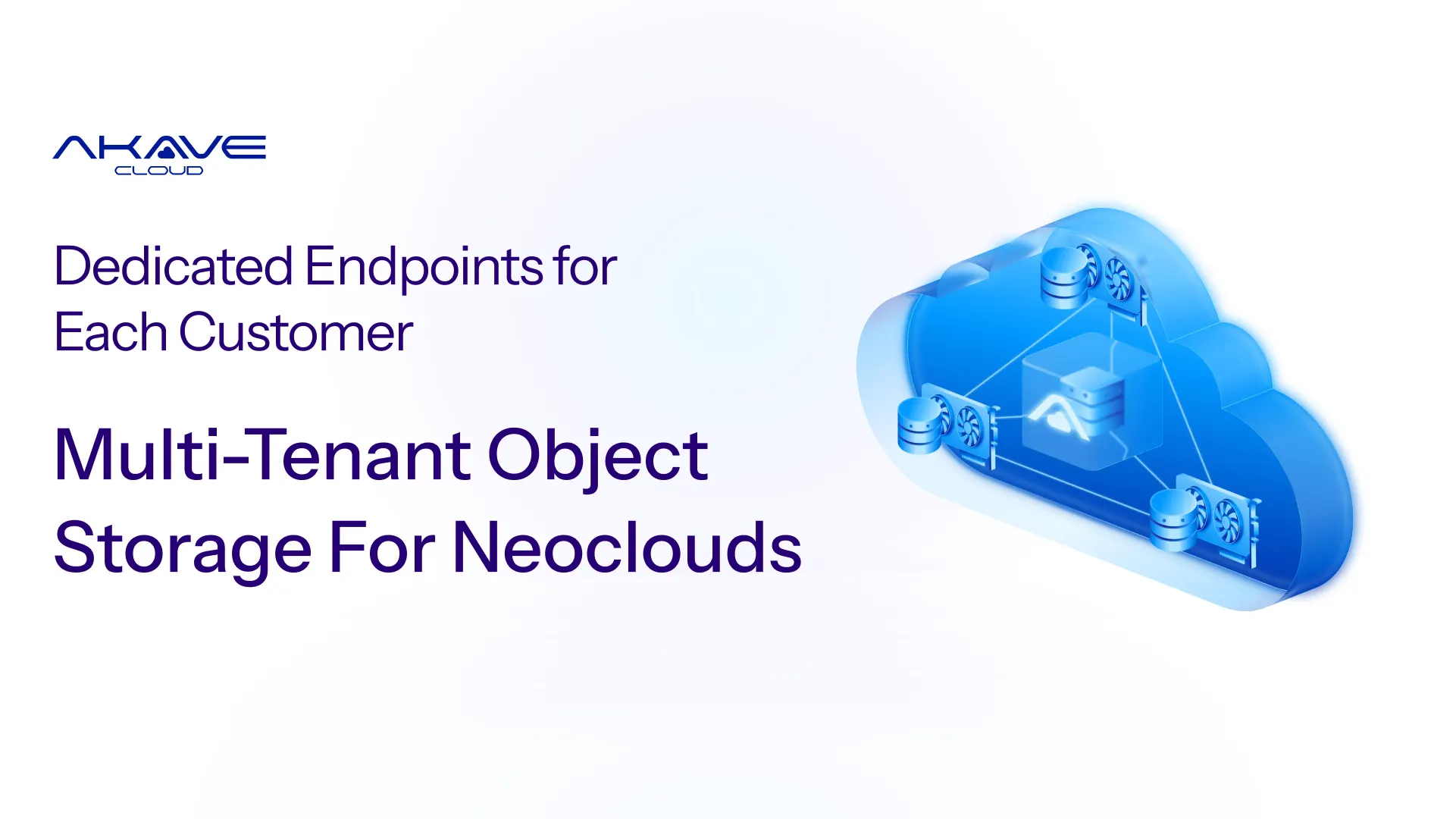
How NeoCloud Operators Prove Tenant Isolation Architecturally, Not by Assurance
A policy document describes tenant isolation. Architecture proves it. When the security architect asks "prove our training data cannot reach another tenant," the answer needs to survive adversarial review. This post explains why the storage layer is where that proof lives, and maps the four properties that produce it: isolated endpoints, BYOK keys, ledger-tracked operations, and provable deletion.

Zero Egress as a Differentiator in the GPU Contract for Neoclouds
A NeoCloud operator who wins on GPU rate alone has a floor any cheaper competitor can undercut. An operator who bundles flat-rate, zero-egress storage turns training data into a retention mechanism, eliminates the hyperscaler egress bill the tenant was paying separately, and gives compliance teams a BYOK data foundation they cannot get from Cloudflare R2. This post makes the commercial case.
The sovereign AI infrastructure stack: sovereign compute plus sovereign storage
When GPU prices converge, a price-only NeoCloud has no floor. This post explains the mechanism that changes that: bundling Sovereign AI Storage Infrastructure, tenant-held keys, isolated endpoints, a ledger of every operation, and provable deletion, shifts the switching cost from the compute contract to the data itself. The result is a four-question evaluation framework (cost, performance, compliance, agentic readiness) that a cheaper cluster can answer at most one of.
How NeoCloud Operators Turn Storage Into a Revenue Line, Not a Cost
A 100-GPU tenant at $23/TB plus $0.09/GB egress: at 500 TB that is $11,500 per month, flowing to a hyperscaler that competes with you. This post covers why it stays there, why Q1-Q2 2026 hardware costs make the tiering gap more urgent, and how bundling flat-rate, zero-egress storage at $14.99/TB changes the economics of every contract you already run.

When Your Cloud Provider Is Also Your Competitor's Backer
When the companies that fund, host, and compete with the AI labs your stack depends on are the same companies, AI data sovereignty stops being a policy checkbox. It becomes an infrastructure decision. Up to $40 billion in equity into a single AI lab from one cloud provider. A US company's EU data-center address does not change which legal system can compel its parent under the CLOUD Act. When your cloud provider is both a financial participant in the AI race and the single point of legal compulsion for your data, that is a sovereignty gap the contract does not close. Five questions to find yours.
OpenSharing Solved AI Distribution. Auditability Is the Next Layer
OpenSharing (June 16, 2026) extends Delta Sharing's success from tables and files to the full AI stack: datasets, models, agents, and Genie Agents across any cloud, vendor, and format. Unity Catalog governs who may access shared assets, logs every action, enforces policy. That's excellent access control. What it doesn't provide is operator-independent proof, checkable by an outside party, that the asset a recipient consumed is the exact, unaltered asset the provider published. Governance and auditability are different guarantees. Delta Sharing hit 28,000 recipients on the first. As agent-to-agent workflows scale and EU AI Act Article 10 lands, the second becomes evidentiary.

CoreWeave runs your GPUs, but who can be compelled to hand over your training data?
As CoreWeave joins the Nasdaq-100 on June 22, 2026, neocloud stops being where startups rent spare GPUs and becomes infrastructure institutional enterprise procurement takes seriously. The buying conversation changes: GPU price still matters, but legal review, data protection officers, and audit committees ask different questions. Who can be compelled to access the data? How is multi-tenant isolation proven under scrutiny? The neocloud compute layer was built to answer the first set of questions. The storage layer, where training data actually lives, was not built to answer the second. Two specific failures: CLOUD Act exposure and unprovable multi-tenant separation. Both live in storage.
Verifiable AI Factories: Pairing NVIDIA Confidential Computing with a Sovereign Storage Substrate
GPU-layer confidential computing (NVIDIA H100/H200/Blackwell) attests the enclave computation. It does not prove data provenance. A verifiable AI factory requires five storage properties: (1) ingestion-time cryptographic proof, (2) integrity anchored on a separate immutable ledger, (3) protocol-layer geofencing, (4) tamper-detection guarantees verifiable without the provider, (5) retrieval verification closing the compute-attestation loop.
Sovereign Compute Without Sovereign Data Is Theatre
The EU AI Act doesn't fine you for where your GPUs sit, it fines you up to €35 million for what you can't prove about your data. Every enterprise treating the 16-month Digital Omnibus extension as breathing room is building a remediation problem, not a compliance posture. This post examines why sovereign compute satisfies none of those obligations, what sovereign data infrastructure actually requires, and why the 16-month EU AI Act extension is the last window to build it correctly.
Correctly).webp)
Sovereign AI Is the Next Cloud Lock-In Trap (Unless You Architect It Correctly)
NVIDIA coined "sovereign AI" in 2024. By 2026, AWS, Azure, and Google were selling enterprise versions—but the lock-in architecture stayed vendor-owned. AWS European Sovereign Cloud charges $0.09/GB egress and remains a US subsidiary under CLOUD Act jurisdiction. The fix: check three layers before signing. Compute portability, storage sovereignty (zero egress, customer-held keys), and data provenance (cryptographic audit trails, not vendor logs).
Akave Raises $6.65M to Build the Storage Layer for Sovereign AI
Akave has raised $6.65M to build a compute-agnostic, S3-compatible storage layer for sovereign AI. Akave Cloud delivers flat-rate pricing with zero egress fees, verifiable audit trails, and portable data lake architecture to support AI and analytics workloads without vendor lock-in.
What Sovereign AI Really Means? And Why Control, Not Intelligence, Is the Real Battleground
Sovereign AI ensures organizations maintain control over their data, models, and AI operations, not just where infrastructure runs. As AI becomes decision infrastructure in regulated industries, sovereignty requires more than policy documents. It demands verifiable data provenance, immutable audit trails, and cryptographic proof of compliance.
The 2026 Data Sovereignty Reckoning
A path to true sovereignty. Self-hosted O3 lets you run your own gateway on European infrastructure. Akave provides the protocol and cryptographic tools. You hold the keys. We never have custody of your data, which means we can't be compelled to produce what we don't control. For organizations that need full sovereignty, this is the exit from the impossible choice.
De soevereiniteitsparadox: hoe bedrijven in de EU beide kunnen hebben
Bedrijven in de EU zitten vast tussen het vertrouwen op Amerikaanse hyperscalers met blootstelling aan de CLOUD Act en de overstap naar volledig soevereine clouds die capaciteit opofferen en de kosten verhogen. De echte oplossing is het classificeren van gegevens en alleen het isoleren van de 20-30% waarvoor soevereiniteit vereist is. Een hybride model met door de klant bediende sleutels, nul uitgangen en S3-compatibele workflows biedt zowel soevereiniteit als innovatie tegen lagere kosten dan beide extreme
Europe’s Digital Sovereignty Dilemma: Can the Continent Break Free from US Cloud Dominance?
European data sovereignty means ensuring cloud-stored data remains outside US legal jurisdiction - specifically the CLOUD Act (2018), which allows US authorities to demand access to data held by US-owned companies regardless of where servers are located. Storing data in 'Azure Germany' or 'AWS Frankfurt' does not achieve sovereignty because the parent company remains a US entity. Akave Cloud's decentralised architecture, with no US-controlled single point of legal access, provides a structural alternative.
The Power Struggle: Why Compute Sovereignty Requires Energy Sovereignty in the Age of AI?
Artificial intelligence has entered an era of industrial scale. Large models with hundreds of billions of parameters, trained across thousands of GPUs, are enabling breakthroughs in language, vision and science. Yet this success comes at a cost: electricity is now the limiting reagent for intelligence. Recent reporting has shown that AI data centres can consume as much power as a small city and that cooling these dense clusters of GPUs and TPUs is becoming a primary engineering challenge. When a single training run for a model like GPT‑3 consumes megawatt‑hours of electricity and high‑performance compute clusters require specialized cooling, it is clear that energy is no longer an afterthought, it is the bottleneck. Without reliable, affordable and low‑carbon power, compute sovereignty becomes impossible. This blog makes the case that energy sovereignty, control over the sources, resilience and sustainability of power, is now inseparable from compute sovereignty. We explore the technologies enabling this transition, from small modular reactors and fusion to microgrids, demand response and decentralized physical infrastructure networks (DePIN). We examine the geopolitical and environmental stakes of this transformation and offer actionable recommendations for policymakers and technologists.
Moderne infra. Verifieerbaar door ontwerp
Whether you're scaling your AI infrastructure, handling sensitive records, or modernizing your cloud stack, Akave Cloud is ready to plug in. It feels familiar, but works fundamentally better.