


AI enterprises and research teams are increasingly buying GPU capacity the way they buy any commodity: from whichever provider is cheapest or fastest that quarter, a hyperscaler for baseline, a neocloud for burst, on-prem for sensitive workloads. The teams adopting that model discover the constraint isn't just GPU access. It's data pinned to one cloud that cannot follow the workload, taxed at roughly $0.09 per gigabyte every time it tries. Multi-vendor compute is fast becoming standard practice in enterprise AI. The storage strategy underneath it was designed for a single cloud, and that mismatch is now the most expensive architectural assumption in AI infrastructure. This post covers why storage portability is the real constraint on multi-vendor AI, and what an architecture that lets data follow the workload actually looks like. Akave Cloud is one implementation of that layer: S3-compatible GPU cloud storage at $14.99/TB flat-rate with zero egress fees.
Picture the infrastructure lead at an enterprise AI team, or a research group budgeting a year of training runs, mapping a deliberate multi-vendor compute plan to avoid supplier lock-in. The plan fails at the storage line: every dataset, checkpoint, and artifact sits in one hyperscaler's object store. Moving data to wherever the better GPUs are means paying egress every time. You can test portable, zero-egress storage with a free trial, but the structural trap of single-cloud storage is worth understanding first.
The Compute Stack Just Went Multi-Vendor. The Storage Layer Didn't.
Multi-vendor compute is no longer a contrarian bet. It is how the most sophisticated AI operators now buy GPUs. They split pretraining, fine-tuning, and inference across chipmakers, hyperscalers, and neocloud providers on purpose, because concentration in a single supplier is a supply risk, a pricing risk, and a negotiating weakness. When one vendor's next-generation parts slip a quarter, the workload moves. When a neocloud undercuts a hyperscaler on GPU-hours, the workload moves. Compute has become a commodity that teams shop for continuously.
Storage did not follow. The default pattern is still to land every dataset in the object store of whichever cloud the team started on, then leave it there. That made sense when compute and storage lived in the same building and reads were free within the network. It stops making sense the moment the GPUs a team wants to use are in a different provider's data center than the data.
The result is a quiet architectural contradiction. The compute layer is designed for mobility. The storage layer is designed for permanence in one location. Every time the workload tries to exercise the mobility the compute strategy was built for, it drags a petabyte-scale anchor behind it, and the anchor has a meter on it.
Why Egress Fees Are Structural to Multi-Vendor AI, Not a Discount Problem
Egress is the per-gigabyte charge a cloud provider applies when data leaves its network. Major hyperscalers charge between $0.085 and $0.12 per gigabyte after a small monthly free tier. That number looks trivial. It is not, because in a multi-vendor world the data doesn't move once. It moves every time the workload does.
Pulling a single petabyte out of a major hyperscaler costs between $90,000 and $120,000 in egress alone, before a single GPU-hour is billed. Now layer on how AI actually trains. Models read the same dataset across epochs. Distributed workers each pull their shard. Checkpoints get written and re-read. Fine-tuning runs replay the corpus. Total data movement in a training pipeline routinely runs ten to a hundred times the raw dataset size. When the compute for that pipeline lives on a different provider than the storage, every one of those reads crosses a billing boundary. Industry estimates put the global egress bill at roughly $43 billion in 2025, and AI workloads are the fastest-growing contributor to it.
This is the part teams get wrong: they treat egress as a discount problem. Negotiate committed-use pricing, get the rate down, move on. But volume discounts assume you move data occasionally. Multi-vendor AI moves data structurally, as a condition of running compute where it is cheapest or fastest. A discount on a cost you incur constantly is not a fix. It is a slightly smaller version of the same tax. The egress charge is not a line item to optimize. It is the mechanism that converts your multi-vendor compute strategy back into single-vendor lock-in, one read at a time.
What "Portable Storage" Actually Means When the Workload Moves
Portable storage is storage the workload can reach from any compute provider, at any read volume, without a per-gigabyte penalty for reading it. That is a stricter definition than "we can copy the data out if we have to." Copying data out is exactly the operation egress fees are designed to tax. Real portability means the storage layer stops charging you for reads at all, so that where you run compute becomes an independent decision from where your data lives.
Three properties make storage genuinely portable for AI. First, an S3-compatible API, so any compute provider's environment can read and write the same buckets with no re-architecture and no proprietary SDK lock-in. Second, read economics that don't scale with movement, so a training run that reads a dataset two hundred times costs the same to serve as one that reads it once. Third, an audit trail that travels with the data, so provenance survives the move rather than living in one cloud's logging service that stays behind.
That last property matters more than it looks. When a dataset moves between providers, the question auditors and downstream teams ask is whether it changed in transit. A portable storage layer answers this with content-addressing: every object is identified by a content identifier, or CID, derived from the bytes themselves. Change a single byte and the CID changes, so any modification is independently detectable by anyone holding the reference, on any provider, without trusting the network the data traveled over. The integrity check moves with the data instead of being pinned to the cloud it left.
The Architecture That Lets Data Follow Compute Across Providers
Storage that follows compute needs three things working together: a universal access layer, movement-independent economics, and portable integrity.
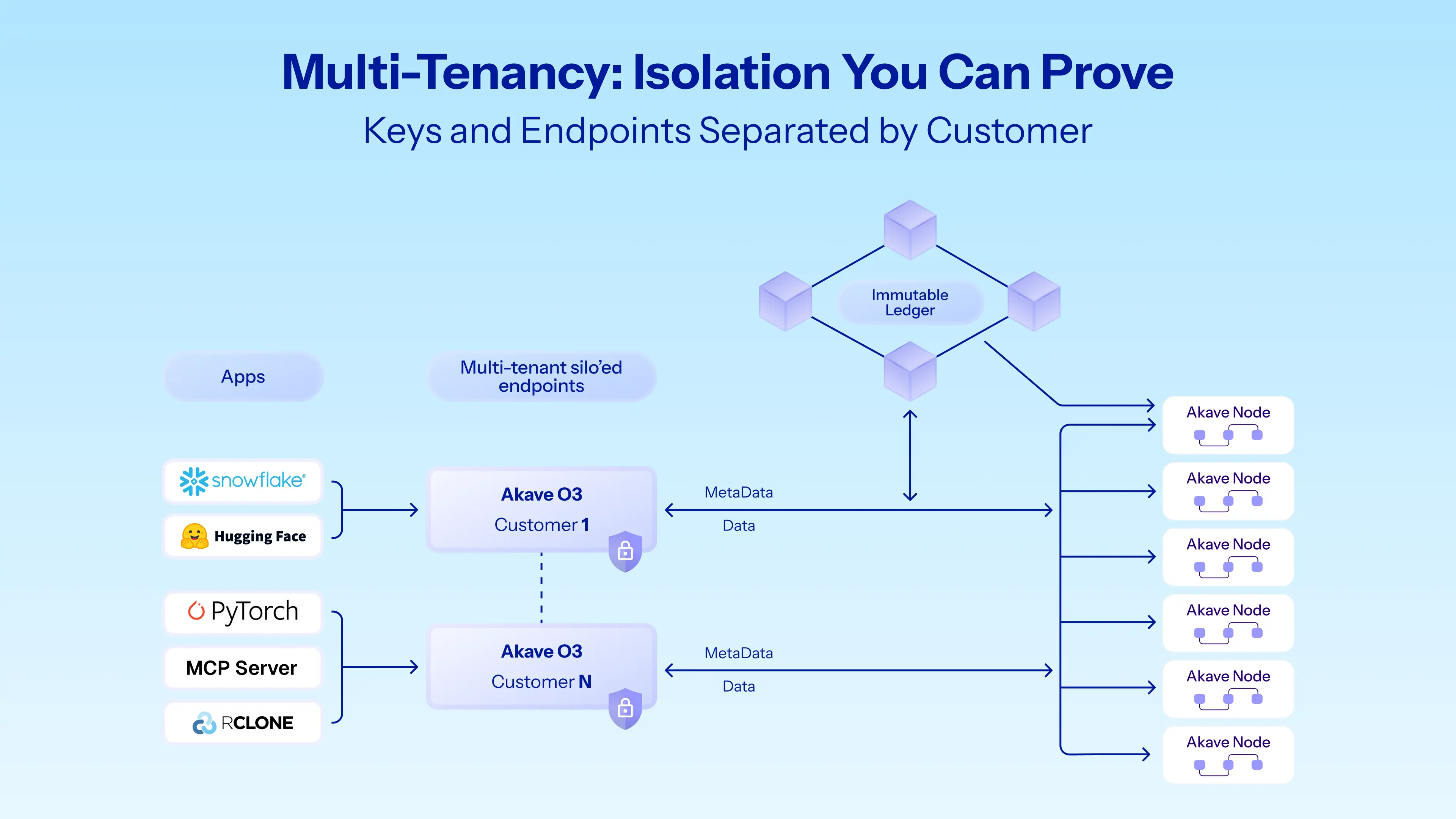
The access layer is S3 compatibility. It is the closest thing the industry has to a universal storage dialect, and every serious compute environment already speaks it. Storage exposed through an S3-compatible endpoint is reachable from a hyperscaler's GPUs, a neocloud's cluster, or an on-prem rig with the same code and the same credentials. Compatibility is what makes the storage location an interchangeable part instead of a dependency.
Akave Plus supports active, multi-vendor training where data is accessed across various providers. Portable integrity relies on an immutable ledger using content identifiers (CIDs). Because this ledger is attested across independent nodes, data provenance is verifiable as it moves. This is vital for autonomous, agentic AI, where consistent S3-compatible access and verifiable provenance are foundational for trust.
Re-Running the Math: Storage Cost Savings
Comparing a 1PB workload, traditional hyperscalers incur significant egress fees, while Akave's flat-rate pricing eliminates this 'egress tax' entirely.
FAQ
What is GPU cloud storage for multi-vendor AI training?
GPU cloud storage for multi-vendor AI training is S3-compatible object storage that a workload can read from any compute provider's accelerator cluster without a per-gigabyte egress charge for each read. Three properties define it: a universal S3 API so any GPU environment connects with existing tooling, flat-rate pricing that doesn't scale with data movement across providers, and content-addressed integrity so provenance travels with the data regardless of which provider it moves through.
What is portable cloud storage for AI workloads?
Portable storage is storage the workload can read from any compute provider, at any volume, without a per-gigabyte egress charge for reading it. It combines an S3-compatible API for universal access, flat-rate economics that don't scale with data movement, and an audit trail that travels with the data.
Why do egress fees matter more for multi-vendor AI?
In a single-cloud setup data rarely leaves the network. In a multi-vendor setup the workload moves to wherever GPUs are cheapest or fastest, and every read from a different provider crosses a billing boundary. AI training reads the same data ten to a hundred times over, so egress compounds with every epoch, checkpoint, and distributed worker.
How much does egress cost at petabyte scale?
Major hyperscalers charge between $0.085 and $0.12 per gigabyte. Pulling a single petabyte out costs between $90,000 and $120,000 in egress alone, before any compute is billed.
Does zero egress apply to all Akave tiers?
Zero egress applies to Akave Plus at $14.99/TB per month flat-rate. Akave Standard at $5.99/TB per month includes egress free up to three times stored capacity per month with a 100TB minimum commitment, not unlimited egress.
How is data integrity maintained when storage moves between providers?
Every object is content-addressed with a content identifier derived from its bytes. Change a byte and the identifier changes, so any modification is independently detectable against the object's root hash by anyone holding the reference, on any provider. The ledger is attested across independent nodes, so no single operator can rewrite it.
Do I need to re-architect to use S3-compatible storage across providers?
No. An S3-compatible endpoint works with existing S3 code and tooling from any compute environment. The typical change is a single endpoint update rather than a rewrite.
Running compute across multiple providers? See what portable, egress-free storage looks like on your own datasets with a free trial. The endpoint change is a single line, the S3 migration and integration docs walk through it. For the full picture on how Akave fits agentic and multi-provider AI pipelines, explore the AI and ML workloads overview.
Sources
- AWS, Microsoft Azure, and Google Cloud official pricing pages, 2025 to 2026: egress fee tiers ($0.085 to $0.12/GB) and petabyte egress math ($90,000 to $120,000 per PB).
- Industry cloud-cost analysis, 2025: global egress spend estimate (~$43B), with AI workloads as the fastest-growing contributor.
- AI training data-movement multipliers (10x to 100x raw dataset size): Epoch AI / Stanford HAI AI Index, 2025.
- Compute commitment context (multi-vendor GPU sourcing across NVIDIA, AMD, Oracle OCI, and CoreWeave; OpenAI's cross-provider compute strategy; Microsoft, Google, Amazon, Anthropic, and SoftBank infrastructure roles): fact-checked AI infrastructure investment analysis, 2026-07-02.
- Akave Cloud pricing and architecture: Akave Cloud pricing page and product documentation, 2026.