


A checkpoint repository cuts GPU cold start delays by keeping model weights and training checkpoints in persistent, S3-compatible object storage staged next to the GPU fleet, so a new node pulls weights over the local network instead of across regions. For a 70B-parameter model, roughly 140 GB of weights, Runway's engineering team measured 2 to 10 Gbps per worker from cloud storage, which puts the weight-loading step at roughly 2 to 9 minutes per node, longer when the fleet pulls simultaneously. Modal reports 10x cold-start reductions using GPU memory snapshots, and NVIDIA Dynamo Snapshot, currently in preview, restores inference workers in approximately 10 seconds on warm nodes. Those approaches work on the compute side. This post covers the storage side: what causes the delay, what a checkpoint repository is, and what to look for when building one. Akave Cloud provides the provider-independent system of record for this pattern: S3-compatible, at a $14.99/TB flat rate with zero egress.
What causes GPU cold start delays
A GPU cold start is the time between a node becoming available and the first training batch starting. Three stages run in sequence, and each one depends on storage.
The container image pull comes first. An uncached pull for a training container can run several minutes, depending on image size and registry bandwidth. Cached images on local disk reduce this to seconds, but node reallocation or preemption clears the cache.
Model weight loading comes second. This is where the delay concentrates for training workloads. A 70B-parameter model carries roughly 140 GB of weights in safetensors format. At 1 GB/s effective network throughput from remote S3, that is over two minutes of GPU time billed but idle. At 10 GB/s, still 14 seconds before the first forward pass. Runway's engineering team found that fleet-wide model rollouts compound this: every node pulling weights simultaneously creates bandwidth contention at the storage backend, pushing individual load times well above single-node benchmarks.
CUDA initialization and graph warmup come third. This stage depends on the GPU model and framework, but it is typically the shortest, seconds rather than minutes.
The GPU-hour meter starts when the node is assigned. Every second spent in cold start is compute billed with zero training throughput.
What a checkpoint repository actually is
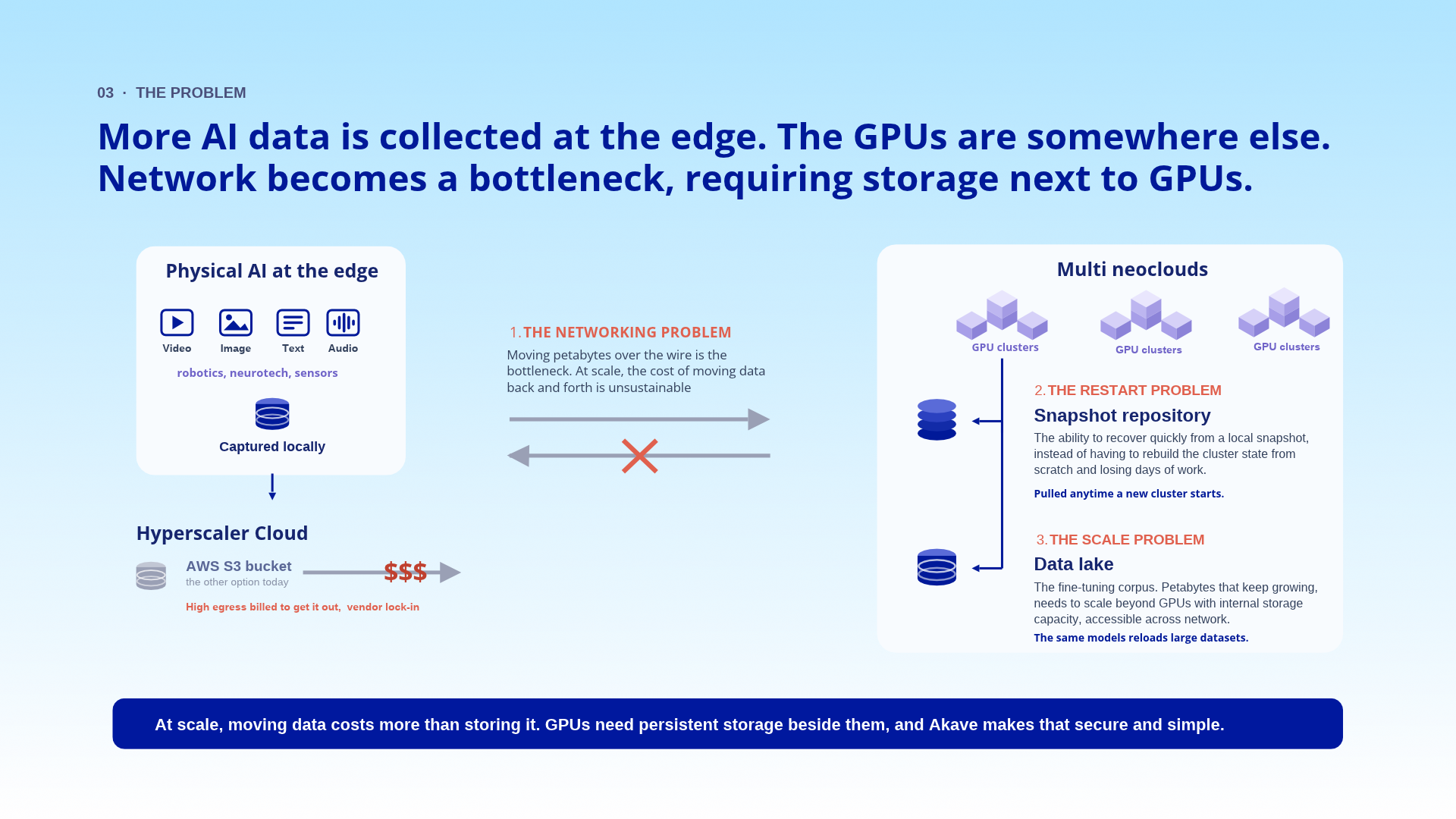
A checkpoint repository is a persistent, S3-compatible object store staged near the GPU fleet that holds model weights, training checkpoints, and container layers ready for immediate local pull when a node comes online.
It is not a cache. Caches are ephemeral, eviction-driven, and node-local. When a node is preempted or reallocated, the cache is gone. A checkpoint repository is durable, versioned, and addressable from any node in the cluster.
The operational pattern: during training, checkpoints are written to the checkpoint repository at configured intervals. When a new node is assigned, it pulls the latest checkpoint from the local repository instead of reaching across regions to a remote storage backend. The weight-loading step drops from minutes to seconds because the data path is local.
This is the storage-side complement to what Modal, NVIDIA, and Beam Cloud are doing on the compute side. Modal's GPU memory snapshots capture full CUDA state and restore it on a new container, cutting cold starts by up to 10x for supported workloads. NVIDIA Dynamo Snapshot, currently in preview, uses CRIU paired with cuda-checkpoint to serialize the GPU process tree to storage and restore it in approximately 10 seconds on warm nodes. Dynamo currently requires x86_64 GPU nodes with recent NVIDIA drivers and supports vLLM or SGLang backends. Beam Cloud reports restoring warmed containers up to 35x faster than a cold start. Each of these operates within a single provider's runtime. A checkpoint repository at the storage layer is provider-independent: the same checkpoint store works whether the next node runs on CoreWeave, Lambda, RunPod, or an on-premises cluster.
Why remote storage multiplies cold start time
The bandwidth math is straightforward. A 70B model is roughly 140 GB. At 10 Gbps network throughput from a remote S3 bucket, the transfer takes approximately 112 seconds. At 25 Gbps, about 45 seconds. From local S3-compatible storage on the same rack or facility, where the path is limited by local network bandwidth rather than internet transit, the same transfer completes in seconds.
The problem compounds at scale. A cluster of 100 nodes cold-starting simultaneously does not each get 25 Gbps from a remote storage backend. They share the backend's aggregate bandwidth. Runway addressed this from the compute side: they had already-running GPUs serve weights directly to new nodes, reporting up to 60x faster cold starts through peer-to-peer weight transfer. But the underlying finding applies to any fleet: when all nodes pull from the same remote storage backend simultaneously, individual load times climb well above single-node benchmarks.
Remote storage also introduces variable latency. Every request crosses an internet path or a cross-region link. Cross-region S3 requests typically add tens of milliseconds per round trip, which compounds when loading thousands of weight tensors sequentially. Local storage eliminates the variable network path entirely.
The architecture question reduces to one thing: does every cold start compete for bandwidth from a remote endpoint, or does the data already sit where the GPU is?
How to set up a checkpoint repository for your GPU fleet
The pattern has four components.
1. Persistent S3-compatible storage near compute. The checkpoint repository is an object store that speaks the S3 API, deployed at the GPU facility or on the same local network. Standard AI tooling, PyTorch data loaders, Rclone, already speaks S3, so no custom integration is needed.
2. Automated checkpoint staging. Training frameworks write checkpoints to the checkpoint repository at configured intervals. PyTorch DCP and Megatron-LM (through NVIDIA's Multi-Storage Client) can write checkpoints straight to S3-compatible storage. DeepSpeed and Accelerate typically write locally and sync with s5cmd or Rclone. The staging runs asynchronously: training continues while the checkpoint writes in the background.
3. Versioned, content-addressed checkpoints. Every checkpoint version gets a unique identifier derived from its content. Content-addressed hashing means the identifier changes if any byte changes. This matters for reproducibility: when a training run resumes from epoch 47, you need confidence that the checkpoint is exactly the one that was written at the end of epoch 47, not a corrupted or partially overwritten copy.
4. Pull-on-assignment automation. When a GPU node comes online, the orchestrator pulls the latest checkpoint from the local checkpoint repository before starting the training loop. The transfer is local, the checkpoint is verified by its content hash, and training resumes in seconds rather than minutes.
What to look for in a checkpoint repository
Five criteria separate a repository that cuts cold start delays from one that just moves the bottleneck.
S3 compatibility. Standard tooling works without adapters. PyTorch, Rclone, s5cmd, and Kubernetes CSI drivers all speak S3. If the storage layer requires a custom SDK or a proprietary API, every tool in the pipeline needs an integration layer.
A staging tier close to compute, backed by a provider-independent system of record. The checkpoint data the GPU pulls must be local to the cluster. But a staging tier tied to a single GPU cloud does not survive a provider switch. The architecture that handles both: a durable system of record that runs independently of any compute provider, paired with a local staging or caching layer at each GPU site. Content-addressed identifiers let you verify that the staged copy matches the system of record exactly.
Checkpoint integrity verification. When an autonomous orchestrator assigns a node at 3 AM and pulls a checkpoint, the question is whether that checkpoint is the same one that was written. Content-addressed hashing, where a changed byte produces a different cryptographic hash, makes any modification independently detectable by anyone with access to the data, not just the storage provider. Runway's engineering team verified that workers must match on exact checkpoint bytes and configuration to avoid silently loading wrong weights. Integrity verification built into the storage layer catches this automatically. Akave's content-addressing delivers this: the orchestrator can prove which exact checkpoint it loaded, not just that one existed.
Provider independence. A checkpoint repository tied to a single GPU cloud does not survive a provider switch. If your training runs move from CoreWeave this quarter to Lambda the next, the checkpoint store needs to work across both without a migration step. S3 compatibility is the baseline, but the storage layer itself must be operationally independent of the compute provider.
Read-optimized architecture. Checkpoint repositories are read-heavy by design. Every cold start pulls weights. Every preemption recovery pulls a checkpoint. The storage layer should be built for repeated, large-object reads without bandwidth throttling or per-read surcharges that grow with volume.
Akave Cloud is the provider-independent system of record in this pattern. It is S3-compatible, content-addressed. Every object gets a CID (content identifier) derived from its content, so any modification, including by the storage provider, is independently detectable. Teams pair Akave with a local staging tier at each GPU site: the staging tier serves the weights at local-network speed, and Akave's content-addressed identifiers verify that the staged copy is the right one. The $14.99/TB flat rate with zero egress means checkpoint syncs between sites cost nothing in transfer fees. The NeoCloud solutions page covers how teams integrate Akave into multi-vendor GPU strategies. The documentation covers S3 tooling configuration.
The storage-side complement to compute-side snapshots
Modal, NVIDIA Dynamo, and Beam Cloud solve cold starts at the compute layer: they snapshot running GPU or container state and restore it faster than building from scratch. These are valid approaches for inference and serverless workloads.
The storage-side problem is different. Training checkpoints are not runtime snapshots. They are data artifacts that persist across sessions, across nodes, and across providers. A checkpoint repository gives those artifacts a permanent, versioned, integrity-verified home close to the compute fleet. Compute-side snapshots reduce initialization time on a single provider. Storage-side checkpoint repositories reduce weight-loading time across any provider.
The two approaches are complementary. For distributed training at scale, both layers matter.
Start with 10 TB free for 2 weeks to test checkpoint staging against your GPU fleet. No credit card required.
FAQ
What is the difference between a checkpoint repository and a local NVMe cache?
A local NVMe cache is fast but ephemeral and node-specific. When a node is preempted, reallocated, or fails, the cache is gone. A checkpoint repository is persistent, versioned, and accessible from any node in the cluster. It survives node failure and provider changes.
Can I use GPU memory snapshots instead of a checkpoint repository?
They solve different problems. GPU memory snapshots (Modal, NVIDIA Dynamo) capture running process state for fast restore within a single provider's runtime. A checkpoint repository stores model weights and training checkpoints as persistent data artifacts accessible via standard S3 tooling, across any provider. For distributed training with provider flexibility, both layers matter.
Does the checkpoint repository need to be at the same physical location as the GPUs?
The staging tier needs to be on the same local network or facility to eliminate cross-region transfer time. The system of record, the durable layer that holds the canonical copy, runs independently and syncs to the local staging tier. This gives you local-network speed for every cold start and provider independence for every migration.
How do I verify that a restored checkpoint matches what was originally written?
Content-addressed storage derives the checkpoint's identifier from its content. If any byte has changed, the identifier will not match. Verification is automatic and independent of the storage provider.
What training frameworks support writing checkpoints to S3-compatible storage?
PyTorch DCP and Megatron-LM (through NVIDIA's Multi-Storage Client) can write checkpoints directly to S3-compatible targets. DeepSpeed and Accelerate typically write to local storage first and sync with tools like Rclone or s5cmd. No custom SDK is needed if the storage speaks the S3 API.
Sources:
Modal GPU memory snapshots (modal.com/blog/gpu-mem-snapshots, July 2025).
NVIDIA Dynamo Snapshot (docs.dynamo.nvidia.com/dynamo/dev/digest/dynamo-snapshot-fast-startup).
Beam Cloud cold start guide (beam.cloud/blog/cold-start-serverless-gpu-inference).
Runway cold start engineering (runway.com/news/engineering/60x-faster-cold-starts-treating-peer-gpus-as-weight-servers, May 2026).
Spheron GPU cold start analysis (spheron.network/blog/gpu-cold-start-llm-inference-2026).