


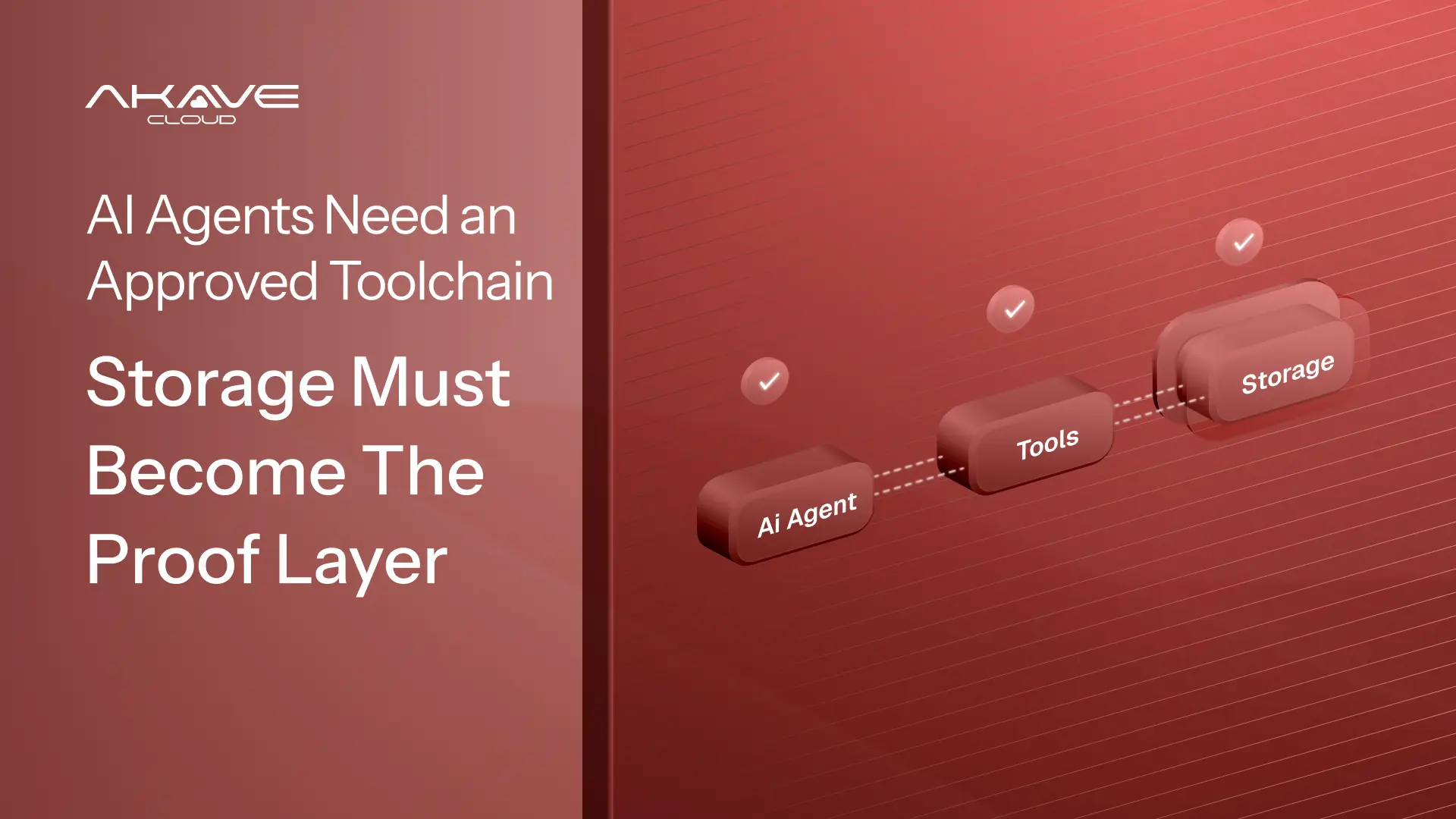
Approved toolchains are not enough. If you can't produce receipts you can verify, you don't have governance when it matters.
Verizon's DBIR key findings make the third-party risk explicit: the share of breaches involving a third party doubled from 15% to 30%.
In agent architectures, every "tool" expands the attack surface. Some tools are external vendors. Some are internal services. Either way, toolchains accumulate dependencies, permissions, version drift, and connectors into systems that matter.
Typical tool surfaces: APIs, SaaS connectors, MCP servers/tool catalogs, retrieval layers/vector stores, and automation runbooks.
When governance is "we wrote a policy" plus "we'll check logs later," incident response becomes a scavenger hunt across vendors and connectors.
Agent governance needs two things: an approved toolchain, and evidence logs you can verify.
Tool registries are becoming change control for agents
Tool governance is turning into product surface area. Google's Vertex AI Agent Builder added Cloud API Registry integration and "enhanced tool governance capabilities", a signal that tool catalogs are becoming a control plane, not glue code.
Operators are already thinking in "approved tools" terms:
"Every server is scanned for vulnerabilities before agents can access it." — Hacker News comment (MCP Gateway and Registry thread)
For agents, a tool registry is where you define:
- Approval: which tools exist, and who owns them
- Scope: what each tool is allowed to touch
- Versioning: what changed, when, and why
- Revocation: how you disable a tool fast when risk appears
- Environment separation: dev vs stage vs prod boundaries that hold
If you run agents in production without an approved toolchain, you are relying on a dangerous default: "anything callable will be called." But approval alone is not governance.
Approval without evidence is audit theater
An "approved tool" can still be used in an unapproved way. OWASP treats prompt injection as a top-tier risk: prompt injection is LLM01.
And the practitioner framing is blunt:
"The great challenge of prompt injection is that LLMs will trust anything that can send them convincing sounding tokens…" — Simon Willison, co-creator of Django and creator of Datasette
Tools are where consequences live: secrets, exports, infra changes, approvals.
So the question is not "Was the tool allowlisted?"
The question is: can you prove what happened, and why the system permitted it, without asking everyone to trust vendor logs?
To be fair: traditional logging is good for operational visibility. It breaks when you need independent verification, cross-tool context, and evidence that survives a hostile review.
Here's what that break looks like: an agent triggers a cross-vendor incident (CRM export, storage write, ticket notification). Legal hold starts. Retention windows don't match, timestamps disagree, one vendor can only provide partial/redacted logs. You can't reconstruct a defensible chain of events. That's an evidence architecture problem.
What a machine-verifiable receipt is (and what it answers)
Logs tell a story. A receipt is a proof artifact.
A machine-verifiable receipt binds one agent action to what an auditor, security team, or platform owner needs:
- Tool identity: name, endpoint, version (ideally a hash of the tool definition/spec)
- Actor identity + policy identity: who/what initiated it, and what policy allowed/denied it
- Input/output references: object IDs/content IDs/hashes and timestamps
- Verification path: how someone can validate integrity without "trust us"
What receipts are not: a second copy of your data, or "centralized logging 2.0." They're small evidence metadata (IDs, hashes/pointers, decisions) that lets you reconstruct and verify events without replaying payloads.
Evidence SLOs: governance you can measure
Once you define receipts, you can define Evidence SLOs. If you're funding this in phases:
- Non-negotiable (fund first):
- Completeness: every tool call yields a receipt (no gaps)
- Binding: each receipt binds policy → tool → data → output
- Verifiability: receipts can be validated independently
- Maturity-stage (fund next):
- Retention: receipts retained for your required window
- Queryability: receipts answer incident questions fast
This is the shift: stop debating whether agents are "trustworthy." Define what must be provable.
Why storage becomes the proof layer?
Every time an agent uses a tool, it creates a data event: read, write, retrieve, transform. That’s why governance doesn’t stop at the model. It runs straight into storage.
Provable storage is object storage that generates a cryptographic proof for every data operation - confirming what data was accessed, when, in what state, and by which process. Unlike standard cloud storage that provides access logs (which can be altered), provable storage creates tamper-proof, mathematically verifiable records. Akave Cloud generates eCIDs (cryptographic receipts) for every storage operation, recorded on the Avalanche L1 blockchain.
Passive storage vs. proof storage
• If storage is passive, evidence ends up scattered across logs, dashboards, and tickets.
• If storage is a proof layer, receipts are bound to the actual inputs/outputs and preserved as durable, verifiable records.
This is also an economic question. IBM’s Cost of a Data Breach report puts the global average breach cost at $4.88M.
And the governance surface is already mainstream: Verizon reports 15% of employees routinely accessed generative AI platforms on corporate devices, increasing the potential for data leaks.
Why now: governance is shipping, and storage is evolving
Three signals show where the market is going:
- Google is embedding tool governance into Vertex AI Agent Builder (Cloud API Registry integration), signaling that tool catalogs are becoming first-class control planes.
- Microsoft is explicitly framing "governing the agent estate" as a control-plane problem (Foundry Control Plane, identity, behavioral controls, observability).
- AWS is pushing object storage into agent-native workloads: Amazon S3 Vectors is generally available, positioning storage as something agents query, not just something you dump data into.
These aren't isolated product launches. They signal market convergence on agent governance and verifiable storage as a unified infrastructure problem.
Where Akave Cloud fits: receipts you can verify
Akave Cloud's has a zero-trust design: "verify, don't trust." That maps to the evidence gap in agent governance: receipts that are stronger than platform logs.
Akave Cloud doesn't replace identity/policy design or "solve" prompt injection. Receipts still require instrumenting tool calls and standardizing identity/policy IDs so receipts bind policy → tool → data → output. Start with the highest-risk tools (export, write, deploy, spend), then expand.
At a high level, Akave Cloud is built around:
- Proof Ledger: verifiable audit metadata attestation onchain
- eCID: encrypted content identity that binds receipts to data artifacts
- PDP (Proofs of Data Possession): strengthens chain-of-custody by proving the data referenced in a receipt is still held as claimed
- Policy enforcement: smart contract policy enforcement designed to be enforceable, not aspirational
"Verifiable" should translate into an action: look up the receipt/audit metadata in a block explorer and confirm the object identity, timestamp, and policy reference match the claimed event.
Economics matter because evidence isn't a one-week story. Legal holds, long retention windows, and cross-tool incident reconstruction make the storage bill part of the governance strategy. Akave Cloud removes two common evidence taxes:
- $0 egress
- $0 API request charges
Base storage is $14.99/TB/month.
Akave Cloud's Possession and Data Persistence proofs (PDP) provide mathematically verifiable evidence that data is stored and intact - auditable through publicly verifiable cryptographic proofs, not provider logs.
A simple evaluation: map the toolchain, then demand receipts
Pressure-test your stack in one hour:
- List every tool (including MCP servers, connectors, retrieval stores, automation actions).
- Mark the actuating ones (write/export/mutate/deploy/spend).
- For each tool, ask one question:
- What receipt do we get for every call, and how do we verify it without trusting the vendor?
If the answer is "we have logs," you don't have receipts.
Tool registries are becoming the control plane. Storage that have built-in attestation proofsbecomes the proof layer. That's what agent governance is converging on.
If you wait to build receipts until after the first incident, you'll learn this under duress. DBIR's third-party involvement doubled from 15% to 30%, and the global average breach cost is $4.88M. When legal hold starts, "we'll piece it together from logs" is not a plan.
Ready to pressure-test your stack? Start with the one-hour evaluation above, or explore how Akave Cloud makes receipts verifiable.
FAQ
What's the difference between a tool registry and a tool gateway?
A tool registry is the catalog and approval surface: what tools exist, who owns them, versions, scopes, and revocation. A gateway is the enforcement and control plane in the path of execution: authentication, authorization, policy checks, and (ideally) receipt emission.
What is provable/tamper-proof storage for AI agents?
Provable/tamper-proof storage is object storage that generates a cryptographic proof for every data operation - confirming what data was accessed, when, in what state, and by which process. Unlike standard cloud storage that provides access logs (which can be altered), provable storage creates tamper-proof, mathematically verifiable records. Akave Cloud generates eCIDs (cryptographic receipts) for every storage operation, recorded on the Avalanche L1 blockchain.
Why do AI agents need provable storage rather than standard object storage?
AI agents make autonomous decisions based on data they retrieve from storage. If that data was altered, corrupted, or accessed without proper authorisation, the agent's decision chain becomes unauditable. Regulatory frameworks like the EU AI Act require high-risk AI systems to maintain complete data lineage - a requirement that standard provider logs cannot reliably satisfy.
How does Akave Cloud's O3 protocol work?
Akave Cloud's O3 protocol generates a cryptographic receipt (eCID - Enterprise Content Identifier) for every storage operation. These receipts are recorded on the Avalanche L1 blockchain, creating an immutable, publicly verifiable record of all data interactions. Possession and Data Persistence proofs (PDP) provide mathematically verifiable evidence that data is stored and intact - auditable without relying on Akave's own server logs.
What storage options exist for AI agent pipelines?
AI agent pipelines can use: standard object storage (AWS S3, Azure Blob, GCP) - no cryptographic proof, basic access logs only; vector databases (Pinecone, Weaviate) - optimised for embeddings, no general-purpose storage; decentralised provable storage (Akave Cloud) - S3-compatible API, cryptographic proofs, full audit trail. For EU AI Act compliance, provable storage is the only option that natively satisfies data lineage requirements.
What is a "machine-verifiable receipt" in plain English?
A receipt is a small evidence record that binds an action to the essentials: who/what acted, which tool/version, which policy allowed it, what data was referenced, what output was produced, and how to verify the integrity later.
Are receipts just "logs, but renamed"?
No. Logs are often fragmented, context-poor, and vendor-controlled. Receipts are designed to be defensible evidence objects that explicitly bind policy → tool → data → output, with an explicit verification path.
Do receipts mean copying all the data into a second system?
No. Receipts shouldn't duplicate payloads. They reference data via IDs/hashes/pointers and store decision metadata (policy, tool, identity) so you can reconstruct and verify events without replaying content.
If I already have CloudTrail + SIEM, do I still need receipts?
CloudTrail/SIEM is great for operational visibility. Receipts matter when you need a defensible chain of events across tools and vendors, especially under legal hold or hostile scrutiny.
What should we fund first if we can't do everything at once?
Start with the non-negotiables: completeness, binding, and verifiability for the highest-risk tools (export, write, deploy, spend). Add long retention and deep queryability after you have coverage and bindings that hold up.
How does "storage as a proof layer" work in practice?
“Receipts are created at the tool boundary (middleware, gateways, or sidecars) and turned into an immutable, verifiable on-chain attestation, linked to the object ID and verification metadata. Storage preserves the proof trail you need to reconstruct what happened.”
Where does Akave Cloud fit (in one sentence)?
Akave Cloud is where actions from your approved toolchain become defensible, onchain attestations. It records receipt metadata and the data’s unique object identity (eCID), enables integrity and chain-of-custody verification (PDP), and makes long-term evidence retention practical with $0 egress and $0 API request charges.